
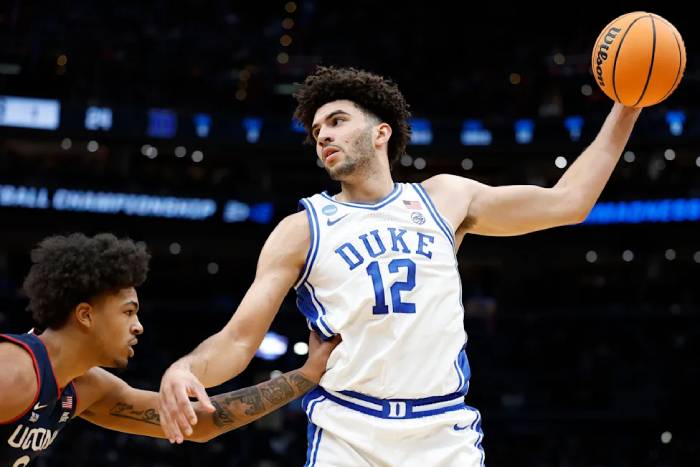
The power forward position concludes our five-part positional ranking series for the 2026 NBA Draft. After examining the point guards, shooting guards, small forwards, and centers, we finish with one of the deepest and most talented groups in the class. The position features a compelling mix of elite freshmen, versatile modern forwards, and accomplished upperclassmen. Headlined by National Player of the Year Cameron Boozer and high-upside freshman Caleb Wilson, this year’s power forward crop offers a blend of skill, athleticism, floor spacing, and defensive versatility that should make it one of the most heavily scouted positions in the draft.
1. Cameron Boozer 6’9”, 255 PF/C, Duke, Fr.
Stats: 38 GP, 22.5 PPG, 55.6 FG%, 39.1 3PT%, 78.9 FT%, 10.2 RPG, 4.1 APG, 1.4 SPG, 0.6 BPG, 2.5 TO
Boozer was the most accomplished freshman in college basketball this season, capturing National Player of the Year honors while leading Duke deep into March. His combination of strength, skill, feel for the game, rebounding, passing, and perimeter shooting gives him one of the safest projections in the draft. He consistently controlled games without needing elite athleticism, using advanced footwork, positioning, and basketball IQ to create advantages. Boozer can score from the post, face up and attack off the dribble, facilitate offense, and stretch defenses with reliable perimeter shooting. His rebounding, toughness, and leadership further strengthen his profile. While some evaluators question whether he possesses elite physical upside compared to some of the other top prospects, his production, versatility, and winning impact make him the clear top power forward prospect in the class.
2. Caleb Wilson 6’10”, 215 PF, North Carolina, Fr.
Stats: 24 GP, 19.8 PPG, 57.8 FG%, 25.9 3PT%, 71.3 FT%, 9.4 RPG, 2.7 APG, 1.5 SPG, 1.4 BPG, 2.0 TO
Wilson possesses arguably the highest upside among frontcourt players in this draft. A fluid, explosive athlete with tremendous length and mobility, he impacts games on both ends of the floor as a scorer, rebounder, defender, and transition weapon. He consistently finishes above the rim, covers ground quickly defensively, and has the versatility to switch across multiple positions. His offensive game remains less polished than Boozer’s, particularly as a perimeter shooter, but his tools are exceptional. Injuries shortened his season after suffering broken thumbs, but his combination of size, athleticism, defensive versatility, and long-term upside makes him one of the most coveted prospects in the draft.
3. Allen Graves 6’9”, 225 PF, Santa Clara, Fr.
Stats: 35 GP, 11.8 PPG, 51.2 FG%, 41.3 3PT%, 75.0 FT%, 6.5 RPG, 1.8 APG, 1.9 SPG, 0.9 BPG, 0.7 TO
Graves has quietly become one of the most fascinating prospects in the class. A former point guard, he brings outstanding feel, ball skills, and decision-making uncommon for a player his size. His ability to stretch the floor, defend multiple positions, generate steals, and impact games without requiring offensive volume has made him a favorite among analytics-oriented evaluators. Graves rarely forces action, consistently makes smart decisions, and plays within the flow of the game. While his statistical production may not immediately jump off the page, his efficiency, versatility, and basketball IQ suggest significant long-term value. Few players in this class fit the modern NBA power forward mold as naturally as Graves.
4. Yaxel Lendeborg 6’10”, 240 PF/SF, Michigan, Sr.
Stats: 40 GP, 15.1 PPG, 51.5 FG%, 37.2 3PT%, 82.4 FT%, 6.8 RPG, 3.2 APG, 1.1 SPG, 1.2 BPG, 1.1 TO
Lendeborg played a major role in Michigan’s national championship run and remains one of the most versatile frontcourt players available. He contributes across every area of the game, serving as a facilitator, rebounder, floor spacer, defender, and secondary creator. His passing ability stands out for a player his size, and his improved perimeter shooting has significantly enhanced his NBA outlook. While he is one of the older prospects in the draft at 24 years old and doesn’t possess elite athletic upside, his ability to impact winning in a variety of ways gives him one of the highest floors among power forwards in the class. Teams looking for a ready-made contributor will find plenty to like.
5. Baba Miller 7’0”, 210 PF/SF, Cincinnati, Sr.
Stats: 35 GP, 13.5 PPG, 45.8 FG%, 35.1 3PT%, 78.2 FT%, 7.8 RPG, 3.7 APG, 1.2 SPG, 1.4 BPG
Miller remains one of the most unique players in the draft. Standing seven feet tall, he offers legitimate perimeter skills, advanced passing ability, defensive versatility, and floor-spacing potential. His ability to handle the ball and facilitate offense resembles that of a large wing more than a traditional big man. Defensively, his length allows him to protect the rim while also defending away from the basket. Consistency remains a concern, as there are games where he can disappear offensively, but the combination of size, skill, and versatility remains highly appealing. Few frontcourt players possess his blend of passing, mobility, and perimeter ability.
6. Koa Peat 6’8”, 245 PF/C, Arizona, Fr.
Stats: 36 GP, 14.1 PPG, 52.8 FG%, 35.0 3PT%, 62.3 FT%, 5.6 RPG, 2.6 APG
Peat entered college as one of the most accomplished high school players in the country and put together a productive freshman season. He combines strength, toughness, footwork, and feel for the game while consistently making winning plays. His passing ability is underrated, and he operates effectively as both a scorer and facilitator. While his three-point percentage appears respectable, the volume remains low and the free throw percentage raises questions about long-term shooting consistency. He lacks elite athleticism and may not have the same upside as some of the players ranked above him, but his skill level, physicality, and competitiveness provide a strong foundation.
7. Trevon Brazile 6’10”, 215 PF, Arkansas, Sr.
Stats: 36 GP, 13.0 PPG, 52.5 FG%, 34.1 3PT%, 71.7 FT%, 7.3 RPG, 1.6 APG, 1.6 BPG, 1.5 SPG, 1.1 TO
Brazile remains one of the more intriguing athletic forwards in the class. His length, mobility, shot-blocking ability, rebounding, and floor-spacing potential fit the mold of a modern NBA power forward. He moves extremely well for a player his size and has the versatility to impact games both inside and outside. Brazile’s ability to contribute as a weak-side rim protector while also stretching the floor offensively gives him valuable two-way upside. Injuries slowed portions of his collegiate development, but the physical tools and flashes of high-level play remain evident.
8. Tobi Lawal 6’8”, 215 PF, Virginia Tech, Sr.
Stats: 23 GP, 12.3 PPG, 54.2 FG%, 25.0 3PT%, 76.3 FT%, 8.5 RPG, 0.6 APG, 1.1 BPG, 0.3 SPG, 1.8 TO
Lawal is one of the most explosive athletes in the entire draft class and arguably the premier vertical athlete among frontcourt prospects. The London-born forward posted a remarkable 45.5-inch max vertical and 40-inch standing vertical at the NBA Draft Combine, numbers that reinforce what appears on film. He plays well above the rim, thrives as a transition finisher, and consistently generates highlight-reel finishes as a lob threat and rim runner. Defensively, his athleticism allows him to cover ground quickly, challenge shots, and defend multiple frontcourt positions. Most of his offense currently comes around the basket, and he remains somewhat raw as a shooter and creator. However, his 76.3% free throw shooting provides some optimism regarding future shooting development. His combination of athleticism, rebounding, defensive upside, and energy gives him one of the highest ceilings among second-tier power forwards.
9. Trey Kaufman-Renn 6’9”, 240 PF, Purdue, Sr.
Stats: 37 GP, 14.2 PPG, 57.8 FG%, 15.4 3PT%, 63.6 FT%, 8.3 RPG, 2.5 APG, 0.4 SPG, 0.2 BPG, 1.4 TO
Kaufman-Renn established himself as one of the more productive interior scorers in college basketball. He combines strength, touch, footwork, and toughness to consistently generate offense around the basket. He excels at carving out space in the paint, finishing through contact, and playing with physicality. His rebounding and passing are additional strengths, helping him contribute beyond scoring. While his perimeter shooting remains a major concern and his athletic profile is fairly ordinary by NBA standards, his skill level and offensive productivity give him a chance to carve out a role as a rotation big man.
10. Rafael Castro 6’10”, 225 PF/C, George Washington, Sr.
Stats: 29 GP, 15.3 PPG, 62.7 FG%, 0.0 3PT%, 66.1 FT%, 9.1 RPG, 1.7 APG, 1.8 SPG, 1.7 BPG, 1.9 TO
Castro rounds out the list after a highly productive senior season. He was one of the most statistically impactful frontcourt players in college basketball, combining elite efficiency with strong rebounding and defensive activity. His 1.8 steals and 1.7 blocks per game are particularly impressive for a player his size and reflect his motor, instincts, and effort level. Castro consistently finishes around the basket, rebounds at a high rate, and brings physicality every night. While he lacks perimeter shooting and projects more as a traditional interior player than many modern power forwards, his production, energy, toughness, and defensive versatility make him worthy of consideration among the top power forward prospects in the class.
Honorable Mention
Maliq Brown – Duke
Tyler Bilodeau – UCLA
KeShawn Murphy – Auburn
Malik Reneau – Miami
Malique Ewin – Arkansas
Mark Mitchell – Missouri
Jaxon Kohler – Michigan State


