
The NCAA Tournament remains one of the most spectacular events in all of sports, and this year’s edition has delivered one of the most exciting opening weekends in recent memory. Despite the evolving landscape with NIL, the drama, intensity, and single-elimination stakes continue to make March Madness a perfect escape and a premier stage for the game. Beyond the spectacle, it also serves as a key evaluation window, though scouts weigh performances within proper context, factoring in team construction, role, and opportunity. The first weekend offered a high-stakes setting to see which prospects step up in big moments, providing valuable insight into competitiveness, adaptability, and performance under pressure. Here are players who have impacted their stock both positively and negatively over the first weekend of the tournament.
Stock Up
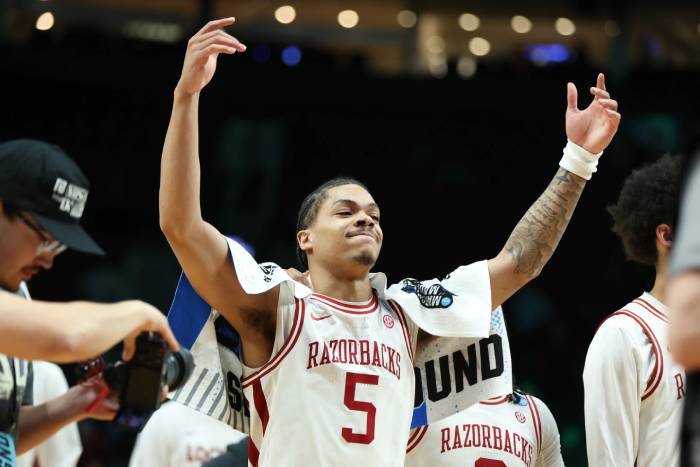
Darius Acuff Jr. (6-2, PG, 2006, Arkansas)
Acuff has elevated his stock with poised, high-level guard play under pressure and has been on a meteoric rise since midseason. He was already trending upward, but his two tournament performances against Hawai’i and High Point showcased his ability to deliver on a big stage. He followed up a 24-point, 7-assist performance against Hawai’i with a dominant 36-point outing against High Point, including a dagger three to seal the game late, putting his clutch gene on full display. He’s showing improved command as a lead initiator, blending scoring bursts with strong pace and decision-making. Acuff consistently creates advantages off the dribble and looks nearly impossible to contain in space, breaking down defenders and getting into the paint to finish or create. His game draws shades of a young Tim Hardaway with his ability to set up defenders, get downhill, and score with touch and creativity in the lane, using floaters, body control, and angles to finish effectively over length. He continues to look like a modern lead guard with scoring instincts and growing playmaking feel, and increasingly like “that guy” capable of overcoming typical size limitations at the next level. He has firmly entered the top-5 conversation and appears to have cemented a spot in the top 10, despite some lingering size and defensive concerns projecting forward.
AJ Dybantsa (6-8, SF, 2007, BYU)
Dybantsa has looked every bit like this year’s top pick, flashing elite shot creation and two-way versatility while separating himself with consistency and availability down the stretch. His dominant second half pushed him to the national scoring title, finishing nearly two points per game ahead of the next closest player. He impacts the game across the board as a scorer, rebounder, and developing facilitator, with the ability to operate as a point forward and create offense at all three levels. In his final game, a loss to Texas, he poured in 35 points while playing all 40 minutes, showing his ability to carry an offense despite going 1-of-7 from three. While Darryn Peterson may have a slightly higher theoretical ceiling, Dybantsa’s production, competitiveness, and reliability will make it nearly impossible for teams to pass on him at No. 1. His defense still needs refinement, but his all-around offensive game and ability to elevate those around him solidify his status as a franchise cornerstone type prospect, with some shades of Tracy McGrady in his handle and pull-up game in a long, fluid 6-9 forward.
Yaxel Lendeborg (6-9, PF/SF, 2002, Michigan)
Lendeborg has been one of the standout performers in the tournament, helping lead Michigan to the Sweet 16 as the Wolverines look like a juggernaut, overwhelming opponents behind their dominant frontcourt. He has it dialed in right now, showing a level of focus and consistency that at times had been a criticism earlier in his career. After a quieter 9-point showing in the opening round, he responded in a big way with 25 points against Saint Louis, including an impressive 3-of-5 from three, highlighting his developing perimeter game. An elite athlete with a massive 7-3 wingspan, Lendeborg is extremely difficult to stop when he’s attacking the basket with purpose. His motor, rebounding, and toughness continue to stand out, and his ability to impact the game across multiple areas on both ends has significantly boosted his stock, with his recent play pushing him firmly into the lottery conversation.
Matas Vokietaitis (6-10, C, 2004, Texas)
Vokietaitis has made a strong impression with his physicality and interior presence, putting together three solid performances throughout the tournament. He plays through contact, carves out space, and finishes efficiently around the basket, highlighted by a 23-point, 16-rebound effort against BYU and a 17-point, 9-rebound showing against Gonzaga. He has held his own against high-level competition, showing toughness and a willingness to embrace physical play. His post footwork and touch around the basket have shown promising signs, and while he isn’t an elite athlete, his size, competitiveness, and interior production stand out. There are still areas for growth offensively, particularly expanding his skill set, but the foundation is there. With his age, turning 22 in November, he may have a real decision to make. He could return to college and continue developing while earning strong NIL value, but if a team shows enough interest to promise him a late first-round selection, he could opt to remain in the draft and begin his professional career.
Meleek Thomas (6-5, SG, 2006, USC)
Thomas has proven to be one of the more dynamic perimeter scorers in the tournament setting. While teammate Darius Acuff Jr. has drawn much of the attention, Thomas has quietly been sensational in his own right, scoring efficiently in both tournament games. He opened with a strong 21-point performance against Hawai’i on 56.3% shooting, then followed it up with 19 points against High Point, continuing his consistent production. He’s a confident shot-maker who can heat up quickly and create his own offense, showing improved shot selection and balance between aggression and control. He’s also done a good job adding strength to his frame and may have even grown an inch since arriving in college, which shows up in his ability to absorb contact and finish. His athleticism and scoring instincts translate well, and he projects as an instant offense weapon whether coming off the bench or in a starting role at the next level, with his stock trending into the mid to late first round range.
Brayden Burries (6-4, PG, 2007, Arizona)
Burries continues to trend upward with his blend of strength, scoring ability, and competitiveness. He has thrived in big moments, attacking downhill and finishing through contact while showing comfort operating with the ball and creating space. As a freshman, he’s leading the No. 1 overall seed in scoring during the tournament at 16 points per game, bringing strong two-way play and filling the stat sheet. He was steady and efficient over the opening weekend, posting 18 points in a win over LIU and 16 points against a tougher Utah State squad, while contributing across multiple categories. His physical profile and mentality stand out, and he looks like a guard who embraces high-level competition and consistently raises his level of play. If he continues to lead Arizona on a deep tournament run while maintaining this level of production, he has a real chance to play himself into the top-10 conversation.
Alex Condon (6-11, C, 2004, Florida)
Condon has made a strong impact with his all-around play, highlighted by a 7-assist performance against Iowa that showcased his passing feel from the frontcourt. Despite Florida’s narrow loss, he was arguably their best player in the tournament, finishing with 21 points on 61.5% shooting while continuing to impact the game in multiple areas. He brings fluidity and mobility for his size, along with the ability to switch defensively and hold his own in space, and plays with consistent energy and competitiveness on both ends. While there are still some skill question marks as a scorer, his versatility, motor, and feel stand out. A proven winner who helped lead Florida to a national title last year, Condon would have a strong case to land in the late first round if he keeps his name in the draft.
Killyan Toure (6-5, G/F, 2007, Iowa State)
Toure has proven one of the breakout freshmen of the opening weekend, delivering a dominant 25-point performance (8-12 FG, 2-3 3PT, 11 rebounds) in a win over Tennessee State. He followed that up with a strong two-way showing against Kentucky, posting 10 points and 4 rebounds in a 20-point win. An elite defender with a high-level athletic profile, Toure brings valuable positional versatility and emerging combo ability. The real intrigue lies in his defensive upside, where he has the tools to develop into a true lockdown presence in the mold of players like Gary Payton II or Iman Shumpert. His impact on both ends, particularly defensively, has quickly put him on the radar as a rising prospect, with late first-round consideration now on the table.
Stock Down
Nate Ament (6-10, F, 2007, Tennessee)
Ament had one of the more disappointing opening round performances, being held scoreless in Tennessee’s win over Miami (OH), finishing with 0 points and 3 rebounds in 18 minutes. For a player with his level of talent and expectations, that outing likely gave some teams pause, particularly regarding consistency and assertiveness. He bounced back with a more productive 16-point effort against Virginia, showing improved efficiency and activity, but the inconsistency across the two games remains notable. Some of the same concerns from his high school evaluation have resurfaced, as his lack of foot speed can make creating on the perimeter more challenging and allows defenders to crowd and muscle him, limiting his space to operate. With Tennessee set to face Iowa State, Ament will have an opportunity to reset the narrative and show he can impact winning at a higher level against elite competition.
Darryn Peterson (6-5, SG, 2007, Kansas)
Peterson and Kansas at times looked disjointed offensively, particularly early in the St. John’s game, and he had an uneven tournament showing overall with stretches of inefficiency and forced offense. He has struggled to find rhythm against set defenses, leading to difficult shot selection. He did flash his scoring upside with a strong 28-point performance against California Baptist, which was an excellent showing and a reminder of his high-end talent. However, he followed that with a 21-point outing in the loss to St. John’s where he shot just 5-of-15 from the field. There were positives in that performance, including going 3-of-8 from three and 8-of-10 from the free throw line, but overall consistency has become an area of concern. He has dealt with major cramping issues throughout the season, which clearly affected his rhythm, cohesiveness with the team, and carried over into the tournament. That situation will need to be addressed, as teams will want clarity and comfort with the root cause to maintain confidence in his lofty draft status, especially as players like Darius Acuff Jr. have been more impactful down the stretch of the season. While his talent and shot-making ability are clear, consistency has become a focal point. With such a high ceiling and prestigious prep career, he’s unlikely to lose much ground in terms of draft position, but this stretch has made it noticeably easier for teams to justify leaning toward AJ Dybantsa at No. 1 than it would have been had Peterson dominated and carried Kansas deeper into the tournament.
Thomas Haugh (6-9, F, 2003, Florida)
Haugh falls into the stock down category after struggling to consistently play to his ability during the tournament. While he remains well regarded by scouts for his toughness, maturity, focus, and team-first approach, his efficiency issues from the second half of the season carried into March. In Florida’s loss to Iowa, he put up 19 points but did so on just 3-of-11 shooting and 2-of-8 from three, reflecting the inefficiency that has become a concern. He was solid overall but not impactful enough to elevate the team in a moment where more was needed. Despite this stretch, his projection remains relatively stable. He is still viewed as a potential mid-first round pick due to his plug-and-play versatility and ability to impact a winning team without needing high usage. On the positive side, his clutch gene and key role in last year’s national title run remain strong points in his evaluation, reinforcing the appeal of a Jaime Jaquez-type forward who can contribute across the board.
Cameron Boozer (6-9, PF, 2007, Duke)
Boozer hasn’t had the level of impact expected relative to the hype, particularly as a primary offensive option. From a statistical standpoint, he has been productive, scoring 22 and 19 points while consistently rebounding at a high level, continuing the steady output he’s shown all season. Where he has struggled is knocking down perimeter shots, going just 1-of-6 from three across the two games, and asserting physical dominance against lesser competition. The Siena game in particular stood out, as he had difficulty fully imposing his will offensively. At times, he hasn’t looked like an elite-level athlete, which has raised some questions in high-end matchups. He still shows strong fundamentals, feel, and a unique profile with his rebounding strength and ability to space the floor from the four spot. There’s still time to shift the narrative, but this stretch has raised some questions about whether he possesses truly elite-level athleticism at the highest levels.


