
“Situational Analysis” is a series of articles that seeks to examine the circumstances that most often influence an NBA prospect’s success. Each player will be scored on a scale from 1-10 in four different categories: NBA-specific skill(s), fatal flaw(s), collegiate/overseas/pre-NBA environment, and ideal NBA ecosystem.
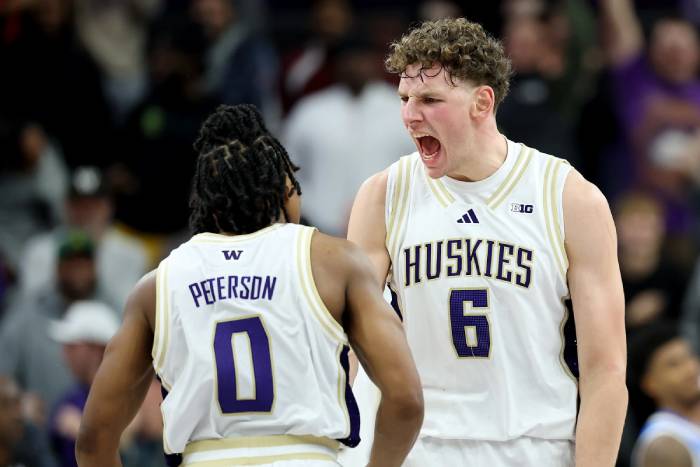
Hannes Steinbach is a 20-year-old forward/center from Germany who averaged 18.5 points, 11.8 rebounds, and 1.6 assists for the Washington Huskies. He is expected to be a mid-first-round pick the 2026 NBA Draft. NBADraft.net currently has him projected at No. 10.
NBA-Specific Skills
A truly elite skill can be the difference between a 15-year NBA career and one that wraps up before the end of a player’s rookie contract.
It’s tough to crack an NBA roster if you’re OK at everything, but not great at anything. Players at this level obviously need to hit a certain level of competence at all the core basketball skills, but those who tend to separate themselves have at least one skill that rises above the competition.
Hannes Steinbach possesses such a skill. This young man rebounds the basketball better than anyone in this draft.
Steinbach led the entire NCAA with 11.8 rebounds per game and a rebounding rate of just under 20%. He is a very good athlete (35.5-inch vertical), but he doesn’t keep the glass this clean relying solely on eye-popping vertical leaping ability. Steinbach positions himself, boxes out, and secures the ball with such regularity that it stops being an accident. Certain players just have a nose for the ball – how shots bounce off the rim and what angles lead to advantageous positioning. Steinbach will almost certainly bring this skill with him to the NBA. Rebounding rate tends to translate no matter what.
He isn’t a one-dimensional player, either. Steinbach is an incredibly efficient post player and converts offensive rebounding opportunities with regularity. He spends a lot of time at the line and shoots it well for a big man. As one of college basketball’s most productive big men, Steinbach brings a top-notch work ethic, terrific touch, and an elevated all-around skillset for a freshman.
He’s just under 7 feet with a nice 7-3 wingspan, so he’ll have the size and bulk to bang with most NBA centers.
Defensively, he’s active and intelligent – he rarely finds himself out of position and he communicates well. Defensive possessions don’t end until you secure the rebound, and Steinbach can certainly do that.
On a scale from 1-10, Steinbach’s rebounding rates at a 9.5.
Fatal Flaws
Steinbach’s feel and vision still have a way to go to catch up with his rebounding ability.
Many of the league’s best big men – Alperin Sengun, Domantas Sabonis, and the big guy in Denver who belongs in an entirely separate conversation – mix top-notch floor mapping and playmaking with their rebounding prowess.
Steinbach isn’t the kind of player who can facilitate from the elbows (not yet, anyway), and his paltry 1.6 assists per game don’t speak to a player who will eventually become a playmaker. Of course, he will be surrounded by better talent than he was at Washington, but Steinbach’s game on offense is somewhat caught in the middle. Big men who can’t pass or space the floor (only 1.8 3-point attempts per game) often struggle to separate themselves from the pack. At least one (ideally both) of those skills will need to improve if Steinbach is to develop into a playoff-worthy starting center.
Defensively, Steinbach isn’t a fearsome rim protector or the kind of big with the footspeed to switch on the perimeter. Steinbach will be most comfortable banging down low with other burly centers and grappling for rebounds, but smart teams will work him into pick-and-roll and try to pull him away from the glass.
On a scale from 1 (not a concern) to 10 (serious hindrance), Steinbach’s lack of next-level passing/vision rates at an 8.
Pre-NBA Setting
Steinbach grew up around the game, with a father (Burkhard Steinbach) who played high-level pro ball in Germany. He progressed quickly through the youth circuit, medaling at several high-profile international tournaments and eventually deciding to head to the University of Washington – following a similar path to former NBA great Detlef Schrempf.
The Huskies struggled big time in Big Ten play, due in large part to a lack of perimeter shooting. Despite the cramped floor spacing, Steinbach produced consistently strong counting stats with high efficiency.
He was one of the big winners at the NBA combine, measuring bigger and more athletic than many Steinbach skeptics expected. He is a clear NBA player and one of the big sleepers in this year’s draft.
On a scale from 1-10, Steinbach’s pre-NBA career rates at about a 7. Even though Washington’s struggles weren’t entirely his fault, they lost more games than they won.
Ideal NBA Ecosystem
Steinbach is going to produce no matter where he ends up. It’s just a matter of whether the ancillary skills (perimeter shooting, passing/facilitating, defense) evolve to a point where he is a starting-caliber center along the lines of Ivica Zubac, or a rotation/backup big man along the lines of Jonas Valanciunas.
In my mind, Steinbach will end up at least as good as fellow German Isaiah Hartenstein, which is why Oklahoma City makes a ton of sense for Steinbach at No. 12. The Thunder will soon have many difficult financial decisions to make, and Harteinstein (who was essential in OKC’s recent playoff run) may be among those eventual cap causalities. Steinbach could spend a season or two as a Hartenstein apprentice before stepping in as OKC’s primary rebounder.
It’s entirely possible that Steinbach isn’t available at No. 12. Atlanta at No. 8 needs additional size/bulk in the worst way. The Hawks gave the New York Knicks trouble in the first round of the playoffs until New York’s size advantage simply became too much to overcome. Atlanta has plenty of wing depth and athleticism. They need a bully on the glass.
Milwaukee at No. 10 also makes a great deal of sense. Whether they embark on a post-Giannis rebuild or attempt to regain playoff relevance with him, Steinbach brings a much-needed dose of physicality and would likely push his way into the rotation ahead of a disappointing Myles Turner.
If Steinbach is still on the board at No. 14, the Charlotte Hornets would likely snap him up. It wouldn’t be too much fun for any big man rotation trying to box out a combination of Steinbach and Moussa Diabate for 48 minutes.
Steinbach is a seemingly situationally independent player, given how every team in the league needs big-man depth and rebounding. But for him to reach his full potential, he’ll need a team that will trust him to spread his wings with the ball in his hands and help him see the complexities of the game at a new level. Let’s put his situational dependence at an 8.5


