
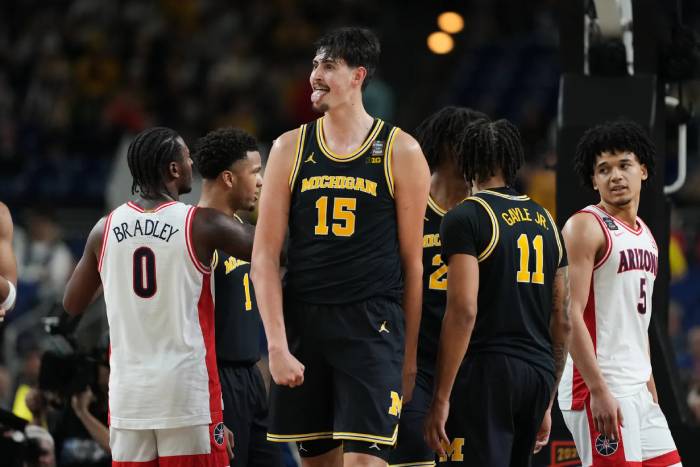
“Situational Analysis” is a series of articles that seeks to examine the circumstances that most often influence an NBA prospect’s success. Each player will be scored on a scale from 1-10 in four different categories: NBA-specific skill(s), fatal flaw(s), collegiate/overseas/pre-NBA environment, and ideal NBA ecosystem.
Aday Mara is a 21-year-old center from Zaragoza, Spain who averaged 12.1 points, 6.8 rebounds, and 2.6 blocks for the national champion Michigan Wolverines. He is expected to be a mid-first-round pick the 2026 NBA Draft. NBADraft.net currently has him projected at No. 21.
NBA-Specific Skills
Basketball will always be a sport that favors the tall.
Height isn’t everything, obviously, but it sure helps when you can touch the rim on your tiptoes – something Aday Mara and an exceptionally small number of individuals can do.
Offensively, Mara was an exceptionally efficient roll man for the Wolverines, scoring 12 points a game on lobs, rolls, and putbacks. His 67% shooting percentage placed fourth in the entire NCAA – he is a low-mistake, intuitive player who also knows how to keep the ball moving (2.4 assists per game is a surprising number for a finisher like Mara).
But it’s the defensive end that has propelled his meteoric rise on many draft boards.
At 7-3 with a 9-9 standing reach, Mara doesn’t just protect the rim. He blots out the sun.
Mara anchored Michigan’s championship-level defense with truly elite shot deterrence. The 2.6 blocks per game barely tell the story. Many would-be rim attacks simply never materialized with Mara patrolling the paint. Opponents shot less than 55% at the rim with Mara around, and he blocked nearly 12% of the shots taken in his vicinity.
With the NBA balance of power tilting toward impossibly tall, impossibly skilled centers, teams will need additional options who can try to keep pace. Mara’s undeniable measurables and emerging skills on both ends of the floor make him an intriguing, high-upside answer to some of those challenges.
On a scale from 1-10, Mara’s rim protection rates at a 9.
Fatal Flaws
Victor Wembanyama has everybody shook (for good reason, obviously). But that can’t be the reason why every team loses their mind anytime a super-tall prospect shows the ability to run the floor without falling over.
Outside of Wembanyama – an exception to every single rule put in place now and in the future – the history of the NBA draft is crammed full of intriguing/extra-tall prospects who simply could not play basketball at an NBA level: Hasheem Thabeet, Tacko Fall, Shawn Bradley, Sim Bhullar, Pavel Podkolzin, Bol Bol…do I need to keep going?
A team drafting Mara to be some sort of Wemby-stopper will be sorely disappointed. Mara isn’t nearly as talented, athletic, or skilled as Chet Holmgren, and we all see what happens each time Wemby and Chet square off.
Even setting aside Wemby for a second, it’s unclear whether Mara possesses the footspeed to defend in space against any NBA-level pick-and-roll attack. He’s tall, certainly, but he isn’t very explosive (28-inch max vert) and he doesn’t provide any floor spacing at all (three made 3-pointers on 10 attempts over three college basketball seasons). His career foul-shooting percentage (58.5%) provides little optimism to him ever being able to shoot the ball from beyond the elbows.
Outside of shotblocking and at-rim finishing (two A-plus skills, mind you), it’s unclear whether Mara has a third skill that would justify him being a lottery selection. At age 21, he is at least two years older than most lottery-bound players – especially concerning, as most view him as a developmental prospect (similar to the path Khaman Maluach has followed in Phoenix).
On a scale from 1 (not a concern) to 10 (serious hindrance), Mara’s lack of footspeed and explosiveness rates at a 9.
Pre-NBA Setting
Prior to his arrival in the United States, Mara bounced around the Euroleagues in Spain, showing just enough promise as a rebounder and shotblocker to earn college scouts’ attention. Despite weird contract disputes and NCAA eligibility concerns, Mara eventually made his way to UCLA.
In two years with the Bruins, Mara barely saw the floor and was viewed as a second-round flyer at best. He would show flashes of defensive dominance alongside bouts of inconsistency and foul trouble.
He came into his own with the University of Michigan, where he anchored a title-winning defense, won the conference’s defensive player of the year, and propelled himself into the 2026 lottery conversation.
On a scale from 1-10, Mara’s pre-NBA career rates at an 8.5, with a sharp, almost shocking increase toward the end.
Ideal NBA Ecosystem
Mara found success at Michigan thanks in large part to the roster’s loaded front line (Yaxel Lendeborg and Morez Johnson are likely going in the first round of this year’s draft, as well). A team needs to view Mara as a shotblocking bonus to an established big man rotation, as opposed to the solution for all of its center needs.
Some mock drafts have him going as high as Atlanta (No. 8) or Dallas (No. 9). Atlanta checks a lot of boxes on paper, given the need for some rim protection behind the Hawks’ group of ultra-athletic wings, but Mara feels like a reach, given the guard talent we have at this point in the draft.
If Oklahoma City doesn’t move off picks 12 or 17, Mara makes sense here. The Thunder already have plenty of big-man depth (Holmgren, Isaiah Hartenstein, Jaylin Williams, last year’s lotto pick, Thomas Sorber), but they’ll have many cap-related decisions to make, and Mara could potentially buy them short-minute bursts against the league’s bigger/longer teams.
Charlotte at No. 14 makes a great deal of sense, as well. Hustle king Moussa Diabate will be back, and Ryan Kalkbrenner showed promise his rookie season, but additional big-man depth could turn this team from a fun play-in story into a real-deal playoff contender.
NBADraft.net currently has him slotted to go to the Detroit Pistons – a team built much like the home-state Wolverines, with its reliance on size and physicality. Jalen Duren’s uninspiring playoff performance might signal a need for additional depth.
In terms of situational dependence, Mara is a 10. He needs a coaching staff that sees his potential and a training staff that can build his athleticism.


