
With the 2026 NBA Draft now just two weeks away and individual workouts in their final stages, it’s a good time to take a closer look at the top talent at each position. Point guard is the first group we will examine, featuring an especially talented mix of dynamic freshmen, polished upperclassmen, and versatile combo guards with varying paths to NBA success. This year’s class offers impressive depth and multiple prospects with long-term starting upside, led by a pair of highly regarded freshmen in Darius Acuff and Mikel Brown. Acuff has legitimate star potential thanks to his advanced shot creation and offensive instincts, while Brown may possess as much intrigue as any player in the draft if long-term concerns surrounding his back prove manageable.
This group could ultimately produce four top-10 picks and as many as eight first-round selections, making point guard arguably the deepest position in the 2026 NBA Draft. From explosive athletes to polished floor generals and jumbo creators with long-term upside, teams seeking backcourt help should have no shortage of appealing options throughout the draft.
1. Mikel Brown 6’5”, 190 PG Louisville, Fr.
Stats: 21 GP, 41.0 FG%, 34.4 3PT%, 84.4 FT%, 18.2 PPG, 3.3 RPG, 4.7 APG, 1.2 SPG, 3.1 TO
Brown heads into the final stretch before the draft as one of the highest-upside guards in the class and a prospect carrying as much intrigue as any player in the draft. At 6’5”, he offers outstanding positional size, advanced feel, and a polished offensive package. Brown comfortably toggles between scoring and facilitating, sees over defenses well, and consistently makes the right read. More quick and shifty than outright explosive, he creates separation through craft, hesitation moves, and outstanding pace. Despite shooting just 34.4% from three this season, Brown remains one of the very best pure shooters in the draft based on mechanics, touch, shot difficulty, and long-term projection, highlighted by a 45-point explosion against NC State in which he buried 10-of-16 from deep. The biggest variable surrounding his projection remains medical evaluations, as back issues have lingered for multiple seasons and limited his availability, including during the NCAA Tournament. If his back proves to have no long-term issues, Brown may ultimately prove to be the most impactful long-term prospect at the position.
2. Darius Acuff 6’3”, 185 PG Arkansas, Fr.
Stats: 36 GP, 48.4 FG%, 44.0 3PT%, 80.9 FT%, 23.5 PPG, 3.1 RPG, 6.4 APG, 0.8 SPG, 2.2 TO
Acuff claims the top spot among point guards after a dominant freshman season in which he emerged as one of the most productive and dynamic offensive players in college basketball. One of the premier shot creators in the class, he consistently generated separation off the dribble and thrived as a primary initiator. His handle is tight, he changes speeds explosively, and he possesses deep shooting range that forces defenses to extend well beyond the arc. Acuff took a major leap as a perimeter shooter, knocking down 44.0% from three on strong volume while also showing the confidence to hit difficult pull-ups and late-clock shots. He excels operating in pick-and-roll situations, where his creativity, timing, and ability to make advanced reads stand out. Though undersized by traditional NBA standards, he helped ease some physical concerns during the pre-draft process with strong measurements, including a 6’7” wingspan and 8’2.5” standing reach. His blend of scoring, shooting, and offensive creativity gives him legitimate star upside. The primary concern lies defensively, where greater consistency and engagement will be important against bigger, more physical NBA guards.
3. Kingston Flemings 6’4”, 185 PG Houston, Fr.
Stats: 37 GP, 47.6 FG%, 38.7 3PT%, 84.5 FT%, 16.1 PPG, 4.1 RPG, 5.2 APG, 1.5 SPG, 1.8 TO
Flemings emerged as one of the most explosive young guards in the country, pairing elite athleticism with improving efficiency and growing command of Houston’s offense. He excels getting downhill, applying pressure at the rim, and creating offense in transition. His quick first step and burst make him difficult to contain, while flashes of shot creation and pull-up scoring suggest considerable upside. Flemings showed real progress as a perimeter shooter, converting 38.7% from three while continuing to grow more comfortable operating as a lead initiator. He competes defensively, has the physical tools to become an impact perimeter defender, and plays with the toughness and edge teams covet. One important question for the team that drafts him will be whether to significantly rework his shooting mechanics or simply make smaller refinements to maximize his perimeter potential. The upside is difficult to ignore, and if the jumper continues improving, he could ultimately outperform this ranking.
4. Brayden Burries 6’5”, 215 PG/SG Arizona, Fr.
Stats: 39 GP, 49.1 FG%, 39.1 3PT%, 80.5 FT%, 16.1 PPG, 4.9 RPG, 2.4 APG, 1.5 SPG, 1.5 TO
Burries enjoyed an impressive freshman season and increasingly looks like one of the more versatile guard prospects in the class. Though naturally capable of playing either backcourt spot, his size, passing ability, and feel as a floor general allow him to project comfortably as a big lead guard, while also offering the versatility to slide over and play off the ball when needed. Burries plays with excellent pace and maturity, gets to his spots effectively, and shows a polished scoring package that translates across multiple levels. His strong frame allows him to absorb contact, while his combination of efficiency, toughness, and feel for the game make him one of the safer guards in the class. Whether he develops into a true lead initiator or settles more into a combo guard role will likely determine his ceiling, but the talent level is obvious. There is a strong argument that Burries could ultimately leapfrog Flemings on draft night, as his cleaner, more projectable shooting stroke may give him the higher floor despite Flemings’ superior explosiveness.
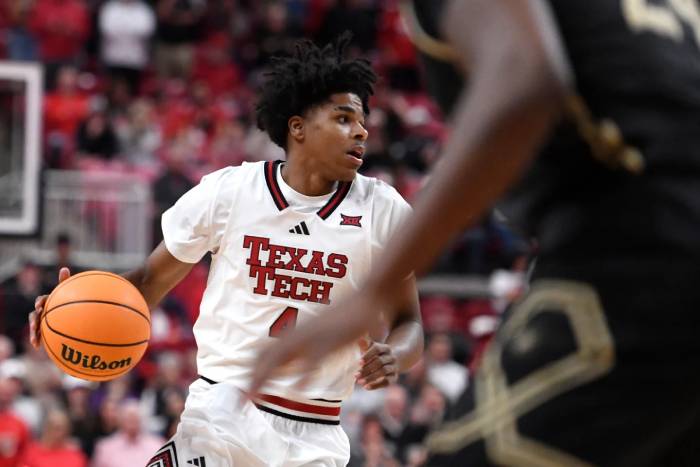
6. Christian Anderson 6’2”, 180 PG Texas Tech, So.
Stats: 33 GP, 38.3 MPG, 47.2 FG%, 41.5 3PT%, 80.5 FT%, 18.5 PPG, 3.6 RPG, 7.4 APG, 0.2 BPG, 1.5 SPG, 2.0 PF, 3.3 TO
Anderson carries momentum as a projected first-round prospect following a highly productive sophomore season, elite shooting numbers, and solid NBA Draft Combine measurements. A crafty offensive guard capable of creating shots and breaking defenses down off the dribble, he changes speeds well, plays with confidence, and consistently pressures defenses with his scoring ability. One of the very best overall shooters in the draft class, Anderson is particularly dangerous pulling up off the bounce, showing deep range, balance, and confidence as a shot maker both on and off the ball. His combination of shot creation and playmaking took a major step forward this season, averaging 18.5 points and an impressive 7.4 assists per game while knocking down 41.5% from three, reinforcing his profile as one of the premier offensive guards in the class. Comfortable operating in pick-and-roll situations, Anderson can score from all three levels while also showing advanced feel creating opportunities for teammates as both a primary and secondary facilitator. His size and lack of strength present some concerns, however, particularly regarding his ability to consistently hold up against stronger, more athletic guards at the NBA level, which could prove slightly limiting in certain matchups. Still, his offensive skill level, shot-making ability, and scoring instincts give him considerable value as a modern scoring lead guard and one of the more polished offensive guards available outside the lottery.
7. Bennett Stirtz 6’4”, 190 PG Iowa, Sr.
Stats: 37 GP, 47.7 FG%, 35.8 3PT%, 84.8 FT%, 19.8 PPG, 2.6 RPG, 4.4 APG, 1.4 SPG, 1.8 TO
One of the biggest stock risers of the season, Stirtz elevated himself into legitimate first-round consideration with his steady production and high-level feel for the game. A cerebral guard who plays under control, he excels as a decision maker and consistently makes winning plays. His passing, poise, and confidence with the ball stand out, while his ability to orchestrate offense should translate to the next level. Though older and lacking elite athletic tools, Stirtz projects as the type of polished, dependable guard capable of carving out a long NBA role. Stirtz further strengthened his stock at the NBA Draft Combine, confirming solid size and better-than-expected athleticism with strong testing results. While his game does not necessarily scream high-level athlete, concerns regarding his physical shortcomings now appear somewhat overstated.
8. Ebuka Okorie 6’2”, 185 PG Stanford, Fr.
Stats: 31 GP, 35.1 MPG, 46.5 FG%, 35.4 3PT%, 83.2 FT%, 23.2 PPG, 3.6 RPG, 3.6 APG, 0.3 BPG, 1.6 SPG, 1.4 PF, 1.9 TO
Okorie emerged as one of the more intriguing freshman guards in the country thanks to his advanced offensive package and high-level production. A crafty scorer with excellent shooting touch and a reported 6’8” wingspan, he consistently showed the ability to score from all three levels while flashing strong pick-and-roll feel and natural playmaking instincts throughout the season. Averaging an impressive 23.2 points per game while shooting 46.5% from the field and over 83% from the free throw line, Okorie showcased a polished offensive repertoire highlighted by advanced shot creation, tight ball handling, and strong scoring instincts. He remains an intriguing long-term prospect, though the biggest question surrounding his projection is how well his game translates in a different role at the NBA level, where he will likely shift from being the primary offensive focal point to more of a complementary player. Questions remain regarding scalability against bigger, more athletic defenders and occasional shot selection, but his blend of scoring ability, shooting touch, playmaking instincts, and feel for the game give him intriguing upside.
9. Sergio De Larrea 6’6”, 175 PG/SG Valencia Basket, 2005
Stats: 7.1 PPG, 2.2 RPG, 2.8 APG, 0.5 SPG, 0.2 BPG, 44.1 FG%, 40.9 3PT%, 81.9 FT%
De Larrea remains one of the more intriguing international guard prospects in the class due to his combination of size, feel, and playmaking instincts. Possessing a classic Spanish point guard feel, he plays with outstanding pacing, vision, and creativity, consistently setting teammates up with advanced reads and timing in pick-and-roll situations. A maestro type of playmaker, he shows patience and feel uncommon for a young guard, manipulating defenses and delivering passes with precision. At 6’6”, he offers excellent size for the position and intriguing versatility to operate both on and off the ball. Despite modest overall production, his strong efficiency numbers stand out, particularly his 40.9% three-point shooting and 81.9% free throw shooting, indicators that align with strong long-term floor-spacing potential and suggest he cannot be left open. De Larrea remains an intriguing prospect, though the biggest questions surrounding his projection center around his slight frame, lack of foot speed, and how well his game translates against NBA length, athleticism, and physicality. Still, his combination of positional size, advanced feel, passing instincts, and shooting touch give him a realistic chance to factor into the first round.
10. Jack Kayil 6’5”, 185 PG Alba Berlin, 2007
Stats: 12.2 PPG, 2.9 RPG, 3.7 APG, 1.0 SPG, 0.2 BPG, 38.3 FG%, 29.9 3PT%, 77.8 FT%
Kayil is one of the more intriguing long-term point guard prospects in the class due to his combination of size, feel, and polish for his age. Possessing very good positional size along with an outstanding 8’5.5” standing reach, he offers a unique physical profile for a lead guard and projects comfortably at the point guard position long term. A polished ball handler with advanced feel, Kayil plays with impressive pace and composure, showing strong instincts as a passer and decision maker while operating effectively in pick-and-roll situations. He consistently makes smart reads, keeps the offense flowing, and shows a mature understanding of tempo uncommon for a player his age. Though his perimeter percentages remain somewhat inconsistent, his clean mechanics and flashes of pull-up shooting ability point toward long-term upside as a perimeter scorer. His strong frame allows him to absorb contact effectively, and while foot speed is a slight concern, he shows enough bounce and athleticism to finish above the rim at times. Kayil remains an intriguing developmental lead guard prospect, with his combination of positional size, physicality, feel for the game, and shot creation upside giving him legitimate late first-round potential.
Honorable Mention:
Jaden Bradley 6’4”, 205 PG/SG Arizona, Sr.
36 GP, 32.4 MPG, 46.3 FG%, 37.1 3PT%, 77.2 FT%, 13.9 PPG, 3.8 RPG, 5.2 APG, 1.9 SPG, 2.1 TO
Bradley is shaping up as a likely mid-second round selection and one of the sleeper candidates in the draft. A highly regarded recruit entering college, he took a slower developmental path but steadily emerged into a productive, dependable backcourt player. Along with freshman standout Brayden Burries, he was a major reason behind Arizona’s dominant season and near-undefeated run prior to its blowout loss to Michigan. Possessing very good size for the position at 6’4”, 205 pounds, Bradley offers a strong frame, maturity, and toughness that should appeal to NBA teams. He competes defensively, provides reliable decision-making and secondary creation value, and made encouraging strides offensively over the course of his college career.
Jakobi Gillespie 6’1”, 180 PG Tennessee, Sr.
Stats: 37 GP, 34.8 MPG, 41.0 FG%, 33.8 3PT%, 81.4 FT%, 18.4 PPG, 2.8 RPG, 5.4 APG, 0.2 BPG, 2.1 SPG, 2.3 PF, 2.3 TO
Gillespie quietly established himself as one of the more productive senior point guard prospects in the country following a strong season at Tennessee. Though diminutive and facing an uphill battle physically at just 6’1”, he is a highly competitive, tough-minded lead guard who consistently impacts winning. A crafty offensive player with strong pace and feel, Gillespie excels operating in pick-and-roll situations, where he keeps defenses off balance and consistently makes sound reads while serving as Tennessee’s offensive engine, averaging an impressive 18.4 points and 5.4 assists per game. Though his 33.8% three-point percentage is somewhat underwhelming compared to other guards in this class, he remains a capable perimeter shooter with solid touch and strong free throw numbers (81.4%) that support long-term optimism regarding his jumper. Gillespie competes hard defensively, generates steals through anticipation and effort, and consistently plays under control. While his lack of size creates legitimate concerns regarding how well his game translates to the NBA, particularly defensively, his toughness, production, competitiveness, and lead guard instincts give him a realistic chance to earn consideration as a reserve point guard option at the professional level.
Honorable Mention:
Kylan Boswell 6’2”, 225 PG Illinois, Sr.
Tre Donaldson 6’3”, 195 PG/SG Miami, Sr.
BJ Edwards 6’3”, 190 PG SMU, Sr.
Tamin Lipsey 6’1”, 200 PG Iowa State, Sr.
Braden Smith 5’11”, 165 PG Purdue, Sr.
Bruce Thornton 6’1”, 225 PG Ohio State, Sr.
Milos Uzan 6’4”, 185 PG/SG Houston, Sr.


