
Player of the Week:
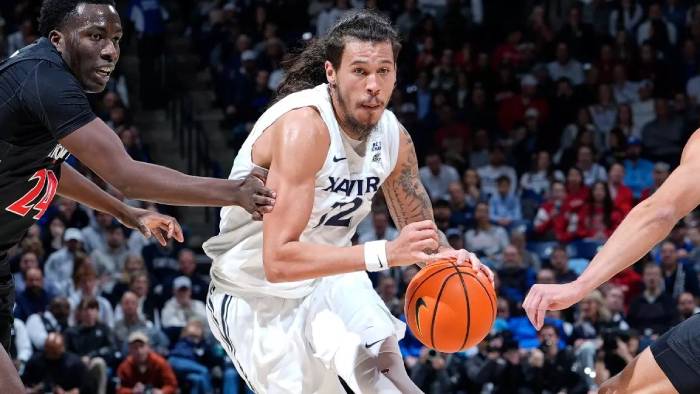
Tre Carroll, Xavier
Tre Carroll earns our Big East Player of the Week and was also officially named the conference’s Big East Player of the Week after continuing his strong start as Xavier’s go-to scorer. He is averaging 17.3 points per game on 48.6 percent shooting from the field and 37.5 percent from three, serving as the driving force behind the Musketeers’ 7–3 start. Carroll’s standout performance came in a rivalry win over Cincinnati on December 5, when he poured in 30 points on 23 shots, lifting Xavier to a five-point victory and solidifying his status as one of the conference’s most impactful early-season performers.
Freshman of the Week:
Braylon Mullins, UConn
Braylon Mullins, a projected 2026 first-round pick with clear lottery potential, has played in only four games due to early-season injuries but has already shown the scoring punch that made him such a coveted recruit. He is averaging 8.8 points in just over 15 minutes per game, and the numbers don’t fully reflect his impact. His best showing came in a five-point win over Kansas, where he scored 17 points on 12 shots in 23 minutes. With his size, length, and natural scoring instincts, Mullins should become increasingly influential as he settles into UConn’s rotation.
Who’s Hot?
UConn Huskies
UConn entered the season overlooked in preseason projections, but they have quickly reasserted themselves as the Big East standard. Riding a five-game winning streak, the Huskies are 9–1 with four victories over ranked opponents and their only loss coming by four points to Arizona. Now fully healthy, UConn has the depth, star talent, and defensive discipline to chase a third national title in four seasons as they head toward conference play.
Solo Ball UConn
Solo Ball has been indispensable for the Huskies, particularly early in the year when injuries thinned the rotation. He leads UConn with 15 points per game on 41.9 percent shooting and provides versatility on both ends, guarding multiple positions and creating offense on or off the ball. He has reached double figures in four straight games, including a 19-point performance in the narrow win over Florida, reaffirming his value as one of the conference’s most consistent two-way contributors.
]Player: Chase Ross], Marquette
Ross has emerged as the conference’s top scorer through ten games, averaging 19.5 points per contest on better than 48 percent shooting. While Marquette has sputtered to a 5–5 record, Ross has been the team’s most reliable offensive weapon and one of the Big East’s most efficient perimeter threats.
Who’s Not?
St. John’s Red Storm
The Red Storm opened the season as the Big East favorite but has struggled to find consistency. The Red Storm sit just above .500 and remain winless in three games against ranked opponents, including an 11-point loss to Auburn. With conference play approaching and a high-profile matchup against Kentucky on December 20, Rick Pitino will rely heavily on his veteran transfer class to stabilize a team still searching for rhythm.
Ian Jackson, St. John’s
Jackson transferred from North Carolina with expectations of elevating St. John’s into true contention, but he has yet to deliver consistently. Jackson is averaging 11.4 points and just one assist per game, and his impact has been minimal in marquee matchups. In three games against ranked opponents, he has averaged only 8.6 points on 44 percent shooting overall and 22 percent from three, a disappointing start for a player expected to be a focal point of the offense.
Josh Dix, Creighton
Dix, an Iowa transfer and preseason All-Big East selection, has not provided the immediate impact Creighton anticipated. He leads the Bluejays in scoring at 11.7 points per game but is shooting only 44.2 percent from the field and 35.4 percent from deep. His struggles have been more evident against top competition, averaging 11 points on 36.8 percent shooting in two games versus ranked opponents, including a 7-point outing on 1-of-9 shooting in a lopsided loss to Gonzaga.
Top Five BIG East Teams
1. UConn Huskies (9-1)
Despite a narrow mid-November loss to Arizona, UConn remains the Big East’s top team. With nine wins in ten games—including four over ranked opponents—the Huskies are excelling on both ends and are finally back to full strength. With a deep roster headlined by NBA-level talent, Dan Hurley has UConn positioned as one of the nation’s most complete and dangerous teams entering conference season.
2. Seton Hall (9-1)
Seton Hall’s strong start includes a win over then-No. 23 NC State en route to a 6–0 opening. Their only loss was a two-point setback to USC. With a veteran roster and a favorable early schedule, Seton Hall will face its biggest tests in late December as Big East play begins, revealing whether this start is sustainable.
3. Butler Bulldogs (7-2)
Butler remains among the conference’s most competitive teams despite a recent loss to Boise State. After beginning the season 3–0, the Bulldogs rebounded well following a narrow loss at SMU. With matchups against Providence and UConn looming, Butler will soon learn how close they are to contending with the conference’s elite.
4. Villanova Wildcats (7-2)
Villanova exceeded expectations after being picked seventh in the preseason, but the résumé is thin. The Wildcats are 0–2 against ranked opponents, including a 28-point loss to second-ranked Michigan. With several tune-ups remaining before Big East play, Villanova will lean heavily on leading scorer Bryce Lindsay, who is averaging 16.4 points per game, to stay in NCAA Tournament contention.
5. DePaul Blue Demons (7-3)
DePaul was picked ninth in the preseason but has started strong, taking advantage of the conference’s easiest schedule to date. The Blue Demons now enter a defining stretch, facing No. 22 St. John’s on the road before returning home for a showdown with No. 5 UConn on December 21. These games will reveal whether DePaul’s early success can translate against top-tier competition.