
This topic contains 1 reply, has 2 voices, and was last updated by 
- AuthorPosts
- Posted on: Thu, 06/07/2012 - 3:40pm #39915

roazurmendiParticipant - Posted on: Fri, 06/08/2012 - 1:53am #678499
orangeshadow83ParticipantMany of us in the NBA analysis business came of age during the era when the league was like a game of king of the hill. For most of the ’80s and ’90s, once a team reached the championship perch, it was awfully hard to knock them off. That’s the way the NBA has always been to a certain extent, save for the relatively wide-open ’70s. During that decade, you had franchises like the Milwaukee Bucks, Golden State Warriors, Washington Bullets, Portland Trail Blazers and Seattle SuperSonics rise up to win championships. The NBA is a little like that now.
More than ever, the league seems to be about putting yourself into position to win a title, then hope the clutch shots, officiating calls, injuries and matchups fall in your favor. It’s not exactly fair to say the league has parity — the chasm between the league’s top and bottom has never seemed greater, in fact. But among the elite, there is a certain egalitarian sense. The top of the league isn’t a perch, it’s a mesa. On it reside a handful of teams, any of which could win a title in a given year under the right circumstances.
The top of the league isn’t a perch, it’s a mesa. On it reside a handful of teams, any of which could win a title in a given year under the right circumstances. … it’s now harder to know when to tear down a contender.
One consequence of the NBA’s current landscape is that it’s now harder to know when to tear down a contender. Michael Jordan‘s decision to tear down the Bobcats was a no-brainer. Charlotte wasn’t on the mesa. Two years ago, there were all sorts of calls to tear down the Dallas Mavericks, who appeared to have plateaued at a non-championship level. Mark Cuban stuck with his core and his coach, showed a willingness to foot the considerable bill that accompanies a top-notch veteran roster, and made some seemingly small roster tweaks. His patience was rewarded by Dallas’ first championship.
It’s a lesson fans of the Spurs would do well to learn today at a time when many of them have to feel like the West is about to become the sole domain of the Oklahoma City Thunder for the next decade or so. If the aging core of the Spurs can’t take down their Thunder counterparts this year, how is next year going to be any different?
Make no mistake: The Spurs’ championship window is still open. Only Chicago has won more regular-season games the last two seasons, so it would be silly to say otherwise. Just a week ago, everyone was ready to concede this year’s title to the Spurs. Now we’re going to blow them up? Nonsense on stilts.
Oklahoma City has surpassed San Antonio, and everyone else, in the West. Chances are the Thunder will keep getting better, though even that is kind of a wild assumption. A certain amount of OKC’s success is due to some otherworldly athleticism, and that can be a fickle commodity. Think back to the Orlando Magic in 1995, who made the Finals when Shaquille O’Neal was 22 years old and Penny Hardaway was just 23. A sustained run of dominance seemed inevitable. Then Michael Jordan returned, Shaq bailed for L.A. and Penny’s knee trouble derailed his Hall of Fame train.
The landscape changes from year to year, and no one should be conceding anything to the Thunder. This year, a full-strength Spurs squad wasn’t good enough to beat a full-strength Thunder squad in a seven-game series. That will probably be even more true next season, but there is no guarantee that the Spurs will have to contend with OKC at full strength. All the Spurs have to do is look at this year’s Eastern Conference, where the last-legs Celtics have exploited a bracket broken open by key injuries.
The Spurs are firmly on the mesa and will remain so as long as Tim Duncan, Manu Ginobili and Tony Parker are an All-Star-caliber foundation. All of them showed in the Thunder series that they still have plenty of game. Parker is a blur and has never been better as a playmaker. Gregg Popovich’s expert handling of Duncan and Ginobili had them playing their best ball of the season in the postseason. It took all of the collective brilliance of Kevin Durant, Russell Westbrook & Co. to dispatch the proud Spurs.
Possible moves?
These days, it’s better to pull the plug too late than too soon. What’s the alternative? Any shake-up of San Antonio’s foundation is going to leave the team worse off than it already is. Plus, given the restrictions of the NBA’s salary cap, the supporting cast can only be tweaked at the margins.
Theoretically, the Spurs could embark on a rebuilding project. Duncan will be an unrestricted free agent. If you let him walk, then you could surely find takers for the expiring deals of Ginobili and Stephen Jackson. Suddenly, you’re leaner, younger and cheaper. The Spurs could then rebuild around Parker. But are they going to be able to construct a new core that’s better than what they’ve got? No way. San Antonio has little choice but to stand pat.
That won’t be tough to pull off. Duncan has been adamant about finishing his career in San Antonio. The only questions are how much longer he wants to play, and for how much money. Will he be looking for a two-year deal? Three years? Four? He told reporters recently that a "year or two" was most likely. Two more years would coincide with the remaining guaranteed years on Parker’s deal, though Ginobili’s deal expires after next season. There is also the possibility that Duncan will commit to playing only next season.
This makes the long-term prospects for the Spurs murky, but next season’s plan should be crystal-clear. The Big Three and Jackson will be back. Supporting players Kawhi Leonard, Tiago Splitter and Matt Bonner are all under contract. That’s the basis of next season’s roster.
Decisions will have to be made on key contributors Gary Neal, Danny Green and DeJuan Blair. Neal’s deal next season isn’t guaranteed, but his production far outstrips the minimum salary San Antonio has him committed to. He’ll be back and possibly even extended. Blair’s situation is similar, though he makes more than the minimum. Still, his deal is also an excellent value, so the Spurs will bring him back, as well. Green will become a restricted free agent and should draw some interest on the market. The Spurs will likely match any reasonable offer he receives.
Boris Diaw will become an unrestricted free agent. He’s an interesting case. He can clearly help a good team but won’t likely receive any huge offers given his nonproduction in Charlotte. Diaw was an excellent fit alongside the Spurs’ veterans. He’s not going to find a better situation than this. The Spurs won’t be willing luxury-tax payers, but if Duncan signs for around $12-14 million per season (that’s pure speculation), they should be able to retain Diaw and stay under the threshold. Since the Spurs don’t have Bird rights on Diaw, he’s going to have to be willing to sign for just above the minimum. Diaw may have to choose fit and comfort over money.
From San Antonio’s perspective, a minimum-salaryish Diaw might be the best the Spurs can do with what little room they have to work with under the tax threshold. If Duncan is willing to sign for just $10 million, there may be enough flexibility to use all or part of a midlevel exception. That’s an option, but it probably wouldn’t be exercised until next year’s post-trade deadline round of contract buyouts, when the Spurs will know more about their chances for another postseason push.
Given the financial restrictions, is there any other way for the Spurs to improve at the margins? What do they need?
The only pick the Spurs have in the upcoming draft is at No. 59, so that’s no help. The Spurs scout so well that you can’t discount the idea that they’ll find a useful player there, but it’s also just as likely that they’ll take another overseas player to stash for the future. In that regard, they have a number of possibilities, such as Nando De Colo, Ryan Richards, Davis Bertans and Adam Hanga.
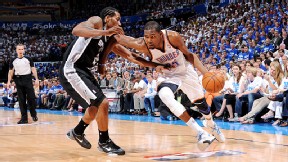 Andrew D. Bernstein/NBAE/Getty ImagesLeonard developed into a solid player, but someone still has to somehow shut down Durant.
The Spurs have one, basic glaring need on their roster, though they are far from the only team to have this void: They need someone who can guard the unguardable Kevin Durant. Durant is a lightning bolt that has electrified the league from basketball’s Olympus, a freakish scourge who isn’t going anywhere anytime soon. How can a player that long be that skilled, that athletic and that driven? Nevertheless, any team that is going to overcome the Thunder will have to find someone who can throw Durant off his rhythm in key situations.
San Antonio’s best chance is for Leonard to develop his already-impressive defensive skill set. One of his primary tasks for this offseason should be to study every move that Durant makes and formulate a counter for it. It’s a near-impossible task, but you have to try. Leonard could be to Durant what Bruce Bowen once was to Kobe Bryant.
Another possibility is for the Spurs to go after Portland’s restricted free agent wing, Nicolas Batum. Batum, like Parker and Diaw, is a Frenchman and would surely feel comfortable playing under Popovich. He’s also 6-foot-8, long-limbed, hyper-athletic and defense-oriented, traits which mark him as a partial solution to the unsolvable Durant problem. However, it’s unlikely the Blazers will let Batum walk; any offer he gets is likely to be matched. The Spurs would have to do some serious tap-dancing to make him a competitive offer, and it’s not worth the risk when Portland would simply match the price.
In the end, the Spurs team we saw walking off the court at the Ford Center on Wednesday is likely going to be virtually identical to the one that starts next season. It will all seem very familiar. They’ll start slow as Popovich eases his veterans into the long season, pick things up around the All-Star break and end up with a solid seed in the postseason. Then it’s a matter of fate. Oklahoma City will be the team to beat, but if the Thunder fall, the Spurs are still on the short list of teams that can topple them. All it takes is a few breaks.
0 - AuthorPosts


| You must be logged in to reply to this topic. | Login |