
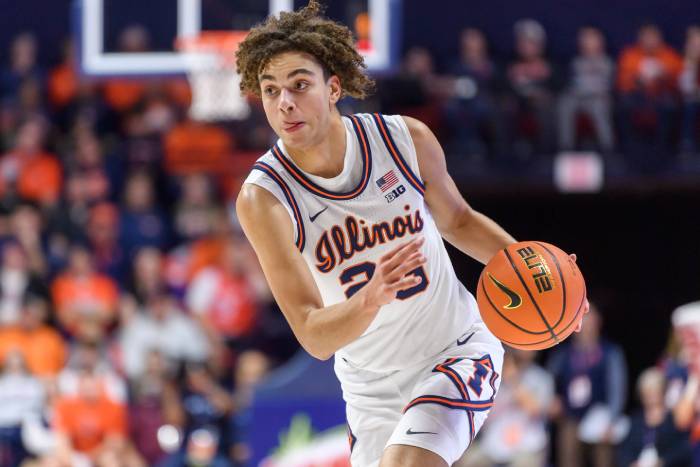
“Situational Analysis” is a series of articles that seeks to examine the circumstances that most often influence an NBA prospect’s success. Each player will be scored on a scale from 1-10 in four different categories: NBA-specific skill(s), fatal flaw(s), collegiate/overseas/pre-NBA environment, and ideal NBA ecosystem.
Keaton Wagler is a 19-year-old guard from Shawnee, Kansas, who averaged 17.9 points, 5.1 rebounds, and 4.2 assists for the Illinois Fighting Illini. He is expected to be a top 10 pick the 2026 NBA Draft. NBADraft.net currently has him projected at No. 6.
NBA-Specific Skills
In today’s NBA, your team is drawing dead if it doesn’t have multiple savvy playmakers who are comfortable with the ball in their hands and can manipulate the defense into opening a quality shot opportunity for themselves or a teammate.
A team can be somewhat successful with one primary playmaker running a heliocentric approach, but even Luka Doncic needs an Austin Reeves – and even a LeBron James! – to help maintain a functional offense against top defenses.
Keaton Wagler is exactly the kind of stat-sheet-filling guard who can step into a secondary playmaker role right away, with enough upside to eventually become a primary one if he continues developing on this trajectory.
Wagler has a point guard’s approach in the body of a wing player. At 6-6 with an 8-4 standing reach, Wagler can find passing angles few other guards have access to. He is an elite pick-and-roll manager going either left or right, and his stellar shooting ability makes it impossible to play under screens. Teams that decide to crowd him are susceptible to his driving/finishing game, where he can convert against bigger defenders and get an opponent into foul trouble (5.8 free throws per game, with multiple games of 10-plus attempts).
Wagler connected on nearly 40% of his 3s as a freshman, with that number approaching 42% in Big Ten play. He can spot up and stretch the floor alongside another ball-dominant player and attack closeouts against a defense caught in rotation. Much like Tyrese Haliburton (a player Wagler often gets compared to), he can run an offense as the lead option or find ways to contribute away from the action.
Take a look at the tape from his Jan. 24 masterpiece at Purdue. Wagler led Illinois to an 88-82 win by scoring 43 points on 17 shots (9-11 from 3, 11-13 from the line). It’s about as well as anyone played all season, considering the efficiency, the opponent, and the situation.
Wagler also rebounds exceptionally well for his position and could one day become a semi-consistent triple-double threat.
On a scale from 1-10, Wagler’s playmaking and versatility rates at a 9.
Fatal Flaws
I must admit – Wagler feeds into one of my main biases as a talent evaluator. I love big point guards. I always have, and I likely always will. Anytime I see a taller-than-expected guard making crisp, clean passes out of the pick and roll and hitting 3s at a 40% clip, I lose track of my senses. I overlook the athletic limitations and simply assume the overall skillset will translate at the NBA level.
When I’m right, it’s Luka Doncic or Dylan Harper. When I’m wrong, it’s Reece Gaines or Michael Carter-Williams.
He’s too good of a shooter to end up like the latter two, but Wagler is going to struggle with the size and speed of NBA defenders next season. It’s unavoidable. He weighs 185 pounds soaking wet, and his wingspan is average at best, which negates some of his height advantages. He isn’t a slouch athletically, but there are other comparable guards in his draft range that are a notch or two better in this regard.
If Wagler’s crafty/IQ advantages at the college level are negated, it’s unclear whether he has that extra oomph to his game to overcome it. So much of a playmaker’s success relies on confidence. You need to believe that pass can slide through the cracks or that the pull-up 3 is going in. If Wagler experiences several “welcome to the NBA” moments his rookie year, only time will tell whether he resilient enough to navigate those early bumps in the road.
There is a better-than-decent chance that Wagler doesn’t achieve his upside with the team that drafts him. We’ve seen dozens of guards with Wagler’s style/approach need a change of scenery (or two, or three) before finding their footing.
On a scale from 1 (not a concern) to 10 (serious hindrance), Wagler’s lack of top-end athleticism and physical strength rate at an 8.5
Pre-NBA Setting
Wagler has taken an unorthodox path to the lottery. He is simultaneously a late bloomer and a fast riser.
Wagler was a solid high school performer, but he didn’t receive offer letters from the typical high-major programs. Despite living less than an hour away from the Kansas campus, the Jayhawks never offered him.
Everyone else’s loss was Illinois’ gain, however, as Wagler quickly established himself as the leader of a solid Fighting Illini squad. His consistently excellent performance during conference play earned him the Big Ten Freshman of the Year award and a spot on the All-American second team.
He elevated his play during the NCAA Tournament, posting some of his best performances when the games mattered most and leading his team to the Final Four before falling in the national semifinals to UConn.
Wagler went from a borderline draft prospect before the season to a surefire top 10 pick in the span of six months. Not bad.
On a scale from 1-10, Wagler’s pre-NBA career started at a 6 and ended at a 9, with an arrow still pointing up.
Ideal NBA Ecosystem
Wagler likely won’t crack the top four in this phenomenal draft class, but he will hear his name called somewhere between picks 5-10.
The Los Angeles Clippers, picking fifth after the lucky/savvy Ivica Zubac trade, make a great deal of sense. Darius Garland is a terrific lead guard, but the Clips will need a slick secondary ball handler with size to pair alongside the diminutive Garland.
The Brooklyn Nets drafted a half-dozen players just like Wagler last year – they have a type – so it wouldn’t make much sense for them to add another one this year. Wagler has a higher upside than any of those picks, however, so perhaps he gets taken here.
The Kings? I wouldn’t wish that on anyone. The team who trades for Wagler after the Kings give up on him too early will have a great prospect on their hands.
Wagler’s floor is likely Atlanta or Dallas. Wagler fits seamlessly into what the Hawks are building, and the Mavericks are in dire need of playmakers to lend a hand to Cooper Flagg and Kyrie Irving.
In terms of situational dependence, Wagler rates at a 9. Wherever he goes, Wagler will need a franchise willing to be patient with his growing pains and allow him enough leeway to make the necessary mistakes to learn how to apply his unique game to the speed and rigor of the NBA.


