
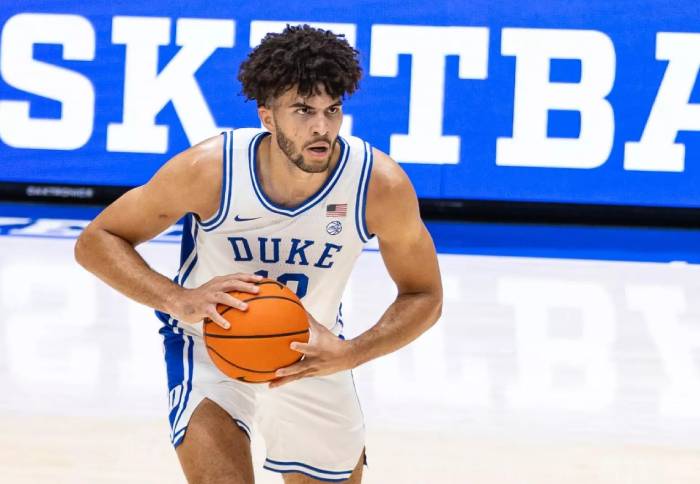
Why Duke Advances:
There is a reason Duke received the number one overall seed in the tournament. At 32-2, the Blue Devils have been one of the top teams in the entire nation all year long. Led by standout freshman Cameron Boozer, Duke has shown themselves capable of going toe-to-toe with anybody in the nation. Their only losses came at the hands of Texas Tech (when JT Toppin was still available) and North Carolina in a game in which Duke trailed for less than half a second. Despite having such a young roster, Duke has made defense their calling card, giving up only 63.1 points per contest this season. Defense travels, and each year we see teams struggle offensively as they transition to using the tournament basketballs and shooting in larger arenas with different backdrops. Duke should be able to lean on their defense during this adjustment period and take advantage of teams that rely heavily on offense. With their height and length, it becomes difficult for teams to prepare for the looks Duke can throw at them. They certainly aren’t upset-proof, but Duke has been phenomenal all season long and should be considered one of the favorites.
Why Duke is Eliminated:
Duke may have been dominant all season long, but this is not the same team we’ve seen all year. Due to injuries, Duke has been without two starters in Caleb Foster and Patrick Ngongba II. Losing a point guard and rim protector is never ideal, and not having them at full strength for the tournament is worst-case scenario. Ngongba could potentially return during the first weekend, which would help, but Duke’s size allows them to better absorb his absence as he works back into the lineup. What Duke lacks is depth at point guard, and Foster, their veteran leader in the backcourt, looks poised to miss extended time. While there is a chance he could return later in the tournament, getting through what might be the toughest bracket without him will be difficult.
Sweet 16 Sleeper:
Louisville Cardinals
Listen, I don’t know how to call anybody in this part of the bracket a sleeper. The top seven seeds are all either top-tier programs or have a Hall of Fame coach. Any of them could reach the Sweet Sixteen and it wouldn’t be surprising. Even if a lower seed advances in the first round, they will likely face another difficult opponent immediately after. So with that, I land on Louisville. The Cardinals have been up and down this season, but when fully healthy, they have looked formidable. In the latest installment of Dude, Where’s My Card, star freshman Mikel Brown Jr. has missed the team’s last four games, with coach Pat Kelsey stating they wanted him fully healthy for the NCAA Tournament. If that happens, Louisville could make some noise, as Brown is one of the few guards capable of matching potential second-round opponent Jeremy Fears Jr. Louisville is 7-5 without Brown and 16-5 with him. They are a team with a high ceiling but a low floor, making them a dangerous wildcard.
Final Four Sleeper:
Michigan State Spartans
Again, this is a tough one. Duke and UConn cannot realistically be considered sleepers. Kansas has the presumptive No. 1 pick in the draft in Darryn Peterson, and St. John’s just won both the regular season and tournament titles in the Big East. I already used Louisville, UCLA has injury concerns, and Ohio State/TCU would have to face Duke early. That leaves Michigan State. It feels strange to call a Tom Izzo team a sleeper, especially as a No. 3 seed, but they have been somewhat overlooked. Jeremy Fears Jr. has been outstanding, averaging 15.7 points and 9.2 assists per game. If guard play determines success in March, that’s a strong foundation. Coen Carr brings elite athleticism and can shift momentum quickly. Michigan State may not be loaded with NBA talent, but they play a style that translates in March, moving the ball well and rebounding at a high level. If they make enough perimeter shots, they could make a deep run.
Top First Round Matchup:
6. Louisville vs. 11. South Florida
If I knew the game would be close and Darryn Peterson would play significant minutes, I would choose Kansas vs. Cal Baptist for the entertainment factor. However, a blowout feels likely. UCLA vs. UCF would be intriguing if fully healthy, but injuries to Donovan Dent and Tyler Bilodeau complicate that. Louisville should have Mikel Brown Jr. back, adding intrigue, while South Florida has enough scoring to keep things competitive. Forward Izaiyah Nelson could challenge Louisville’s frontcourt, and with both teams ranking among the top scoring offenses, this game could turn into a high-paced shootout.
Top Potential Player Matchup:
Darryn Peterson (Kansas) vs. Cameron Boozer (Duke)
It wouldn’t happen early, but a potential Sweet Sixteen matchup between two future top-five picks would be must-watch. Peterson, expected by many to go No. 1 overall, has shown elite flashes despite an inconsistent season due to injuries. Meanwhile, Boozer has been the most consistent player in the country, averaging 22.5 points, 10.2 rebounds, and 4.2 assists while leading Duke to the top seed. The two missed each other earlier in the season, but a March matchup with high stakes would be far more compelling.
Top Under the Radar Matchup:
7. UCLA vs. 2. UConn
This bracket doesn’t feature many exciting first-round matchups, but later rounds could deliver. UCLA vs. UConn is one to watch. If healthy, UCLA matches up well with the Huskies. A frontcourt battle involving Alex Karaban and UCLA’s interior could be key, while the perimeter could feature Donovan Dent against Solo Ball. UConn likely has the edge in depth, but UCLA has enough talent to make this a competitive game that may fly under the radar compared to other matchups in the region.
Top 5 Prospects in the Region:
1. Darryn Peterson, Kansas
Peterson remains one of the top prospects in the draft with elite size, athleticism, and shot-making ability at 6’6”, 205 pounds. He can create his own shot at all three levels and makes difficult looks appear routine. Despite an inconsistent season due to nagging cramping issues, his upside and natural scoring instincts continue to separate him as a potential No. 1 overall pick. A strong showing in the NCAA Tournament could further bolster his case to be selected first overall.
2. Cameron Boozer, Duke
Boozer has been the most dominant and consistent player in college basketball this season. At 6’9”, 250 pounds, he combines strength, skill, and feel, impacting the game as a scorer, rebounder, and playmaker. He is incredibly fundamental with a high level of determination, consistently making the right plays and controlling the tempo. His three-point shooting adds an extra wrinkle not often seen in players with his build. While he may be slightly limited as a pure athlete, his ability to rely on skill, positioning, and basketball IQ makes him a go-to option in the post and one of the most impactful players in the country with strong next-level intrigue.
3. Mikel Brown Jr., Louisville
Despite playing in just 21 games, Brown has flashed elite scoring and playmaking ability, averaging 18.2 points and 4.7 assists. His size at 6’5” allows him to see over defenders, while his creativity and shot-making make him a true offensive engine. He has been nursing a back issue for much of the season, but when healthy, he’s one of the most impactful and high-upside players in the country. Brown can handle and facilitate at a high level, elevating the play of those around him, while also bringing explosive scoring and perimeter shooting. When he gets hot, he can take over games in a hurry.
4. Isaiah Evans, Duke
A 6’6” wing, Evans thrives playing off creators and attacking advantages. He is a high-level shooter from deep who can also put pressure on the rim off the catch. His length and activity defensively add value, making him one of the most effective secondary options in the region. He also brings a level of swagger and confidence as a scorer, capable of heating up quickly and going on scoring runs. That streak scoring ability gives him real X-factor potential for Duke, as he can swing momentum and take over stretches of games when his shot is falling.
5. Braylon Mullins, UConn Huskies
Mullins is a high-level shooter who has been productive whenever given the opportunity. A true marksman from beyond the arc, he spaces the floor at an elite level and brings lottery-level upside with his scoring ability. Beyond his shooting, Mullins offers underrated athleticism and defensive tools that add to his long-term appeal.


