
Well, it’s official, the Denver Nuggets are the 2022-23 NBA champions. And congratulations to them. While many Nuggets players may still be swigging, it’s never too early to start the conversation about an offseason that’s very much already in full swing. Though players like Jamal Murray, Aaron Gordon, and even Nikola Jokic get an immediate reputation bump for their performances during a terrific championship run, there were several other players who also used these playoffs as an opportunity to up their own reps, and with it, their value as they enter free agency this summer. As a wild season has finally come to an end and we fully enter the often equally adventurous offseason, here is a list of guys who will be getting the bag after getting after it for their respective teams during another exciting NBA postseason.
A couple notes before we get into it:
• The presence of 3 Heat players and 3 Lakers on this list speaks to good team building by both franchises, as both teams had great results with cast-offs and undrafted players who made big impacts in the postseason.
• I hope that any team evaluating what they are going to pay for a Miami Heat player takes into account that there is clearly an Eric Spoelstra tax. It’s not that these aren’t good NBA players, it’s just that I’m not sure I’ve seen a coach in my lifetime able to extract more from less than Coach Spo.
• The speculative contract numbers are with me taking into account that with the projected new television deal, and a relatively paltry free agent class, some guys are going to get bigger paydays than they would during a typical free agent cycle.
• While the casual fan may have finally been introduced to Bruce Brown, player personnel people in the league were already aware that he could have this type of impact. While his street cred surely increased, I think he was already slated to get a nice raise if he opts out of his player option—which he seems very likely to do.
Max Strus: Though Strus’s streakiness is clearly a concern, and no one will be paying him to box-out anytime soon, the Heat shooting guard undoubtedly made himself money in these playoffs. Strus’s combination of shooting and movement makes him a great fit for a team looking for some offensive punch off the bench. Strus also showed a competitive edge that kept him on the floor even when his shooting struggles shouldn’t have. The market has a dearth of shooters in this free agent class, so I expect Strus to be overpaid based on the scarcity of his available skill. While I think Strus is a bit over his head as a starter, I could see someone talking themselves into offering a starters role and somewhere in the $12-16 million a year range.
Cameron Johnson: I’m not sure anyone did a better job of using the elevated stage of the playoffs as an opportunity to showcase their depth of skills than Cameron Johnson. In a first-round loss to Philadelphia, the Nets swingman averaged 18.5 points per game, on an impressive 63% true shooting. While his play didn’t do much to prevent Brooklyn from getting swept, Johnson showed a deft ability to hit contested shots on the move and displayed that he can put the ball on the floor to blow by hard closeouts and get up on the rim quickly—Johnson’s posterization of Joel Embiid in game 2 was the dunk of the postseason. Coming off a playoffs in which Johnson proved that there is more to his game than just elite shooting, and considering the wealth of franchises that can utilize a player of his abilities, I expect Johnson to get a huge raise from his rookie deal in what will likely become a bidding war. 4 years for $75-80 million seems a likely landing spot for Johnson’s value.
Rui Hachimura: Few players made themselves more money in less time than Rui did this postseason. After languishing for much of his first four years in the league as a ‘tweener, Rui displayed an offensive game this postseason that showed versatility and high-caliber shot-making. If his playoff performance was reflective of what the former Gonzaga bigman has become offensively, rather than being a by-product of playing with LeBron, Hachimura can be a very productive scorer; particularly if he can be situated around versatile bigs that allow him to play small forward at times. Whomever invests in Rui needs to remember that they are also paying for the player who has averaged 12.5 points per game for his career, not just the player who exploded in the Memphis series. Rui shouldn’t get more than $15 million a season, but I wouldn’t be surprised if someone gets a little too excited by his postseason performance and overpays for a young player who showed some exciting upside during these playoffs.
Gabe Vincent: Vincent had some big moments in the playoffs, showing a penchant for knocking down open shots and creating space by dragging defenders with his movement. But someone in need of a lead guard is going to overpay for the former G-Leaguer. While his position may be listed as point guard, Vincent is more of a 1.5, as Jimmy Butler’s role as the primary ballhandler in Miami’s offense allows Vincent to slide off-ball offensively and switch onto point guards defensively; where his height isn’t the liability it would be against most shooting guards. Vincent is fine in spells as the lead guard—though he only averaged 3.5 assists per game in these playoffs despite playing a little under 31 minutes per game—but his real value comes from what he provides as an off-ball shooter, drawing the defense’s attention with his movement and knocking down catch and shoot opportunities. I think Vincent gets a touch below the $14.5 million a year Tyus Jones got from Memphis last season. The $10-13 million range seems in play, but I have my reservations about that kind of money for a back-up who still only shot 40% from the field during these playoffs, despite it including maybe the best offensive stretch of his career.
Dennis Schröder: In Los Angeles Schröder has refreshed his reputation as a pesky defender, stalking ballhandlers for 94 feet, showing an uncanny ability to poke the ball away after getting beat, and just generally getting under the skin of opposing guards. Offensively, the Lakers guard seems to have figured out how to optimize his ability in the halfcourt to get downhill in a hurry and put pressure on collapsing defenses, as well as becoming a respectable shooter on open looks. Schröder is a player whose fit in LA seems optimal, as he was a large part of their defensive identity and didn’t get into trouble being overmatched as an engine for offense in the same way that he has at other stops. There have also been enough disappointed suitors in the past that I think the market won’t be as strong for Schröder despite him playing a premium position. But the German journeyman definitely displayed that he can still be a highly effective player. Schröder could likely net more than the $4.5 million bi-annual that the Lakers will have to offer, but he would be wise to recognize that LA is clearly the best situation for him professionally.
Jock Landale: Jock Landale is the type of reserve bigman we are constantly told is available all around the league, and yet, Landale was one of very few impactful reserve centers on a roster in these playoffs. If bigmen are so readily available, why the hell don’t the Heat, the Cavaliers, the Warriors, the Kings, the Lakers, or even the mighty Nuggets have a serviceable back-up center? While Naz Reid is my pick for the bigman about to bank the most bucks in free agency, Landale’s high energy play and rebounding will land him a healthy deal for one of the many teams out there in need of a back-up big that they can rely on. I think Landale gets somewhere around 3 years for $27 million, as several teams’ lack of depth at the position became a major problem during this past postseason.
Josh Hart: There are certain players in this league who seem as though they could fit on any roster in the NBA, Josh Hart is one such player. Hart’s combination of effort and intelligence would ingratiate him to any franchise, and while his shooting waxes and wanes, Hart’s effort on the glass is elite for his position—he averaged 7.8 rebounds per game, ranking him third amongst all guards in the league last season. Hart has a player option for next season for a touch under $13 million, but coming off a playoff performance that saw Hart have some highly impactful games, including barely missing a triple-double in a 14 point, 11 rebound, and 9 assist game against Miami, Hart will likely opt-out and cash-in. I would expect him to be in the 3 years for $45-50 million range.
Russell Westbrook: It takes only a cursory scan of my past entries to get a sense of my feelings regarding Russ, but in classic Russ fashion, the former MVP defied perceptions as a whirling dervish of athleticism, tenacity, and spite during the Clippers first round loss to Phoenix. It’s an objective truth that Russ is a tough fit in most systems, but he proved—once again—that he can still be an extremely impactful player in this league. While it does seem that his defensive effort must be spurred by resentment, Russ has continued to accrue jilted franchises for which to direct his vengeful efforts. He clearly didn’t do anything to earn himself more money than his last contract, but prior to his playoff performance this past season, Russ may have been looking at a lot of minimum deals as a third guard off the bench. While he still may have to settle for a reserve role if he decides to chase more money than what the Clippers can offer, someone will have watched the effect he still can have on the tenor of a game and convince themselves he’s worth more. The standard midlevel exception is projected to be around $11 million. It feels like that will be the offer by someone for Russ.
Austin Reaves: I’m not sure any player increased his valuation more than Reaves in these playoffs. After declaring that he is “Him” with an explosive 23 points in the first playoff game of his career, including several big buckets late, Reaves went on to average 16.8 points per game during the Lakers playoff run; including a stretch over his last 7 games in which he averaged 20.6 points on 52% from the field and 57% from the three-point line. In several of the games against Denver in the Western Conference Finals, Reaves was the Lakers’ most dangerous offensive threat in the halfcourt. Reaves’ shooting ability along with his pace and decision-making in the pick and roll will make him a hot commodity in free agency. Hopefully for the Lakers, letting go of Alex Caruso to go big fish hunting for Russell Westbrook was an enduring lesson, as they will have to match healthy offers from the likes of San Antonio and Orlando to keep Reaves. Meaning they may have to forfeit their desire to land another star this offseason. Considering how well he fit alongside LeBron and the fact that Reaves clearly unlocked elements to his game that should see him build on his impressive playoffs, the Lakers should do everything they can to keep him. I wouldn’t be surprised to see Reaves get between $20-25 million a year. That feels a bit steep to me, but someone is going to bet that what we saw in the playoffs is reflective of the type of player Reaves can be on a night to night basis. If so, he’ll earn every cent of that deal.
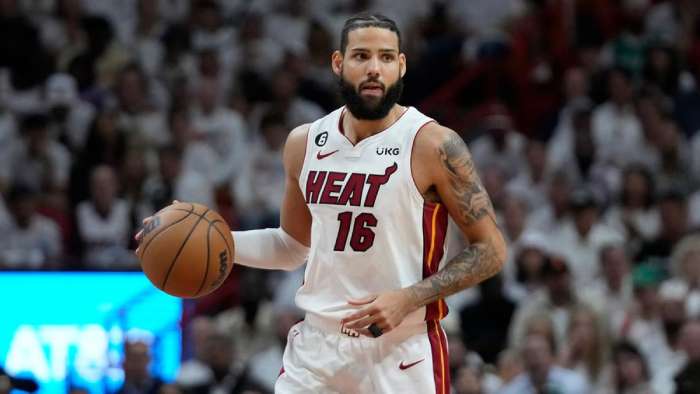
Caleb Martin: Despite coming back down to earth in the Finals after playing out of this world in the Eastern Conference Finals, no player did more to re-shape the perception of who they are as a player than Martin during the Heat’s playoff run. The Heat reserve forward is the only player on this list that isn’t a free agent this off-season, but his play was so good for much of these playoffs that he will be able to cash-in on this run even a year from now. While we all know Miami is the place where undrafted talent goes to blossom, Martin is a player that at one point was thought so little of that the lowly Charlotte Hornets felt comfortable cutting him. Fast forward, and the former Nevada standout was vying for best player in a conference finals series and had an impressive 63.6% effective field goal percentage for the entirety of this postseason. I’m not convinced that Martin has finally figured out his shot enough to be a knock-down threat—he has a bad habit of shooting on the way down, leaving his shot short, particular on the move—but the poise that he showed offensively and his defensive versatility have not only changed his perception as a player, they have likely changed where the coma lands on his next contract. Martin has a player option in the 2024-25 season for a little over $7 million, but after this playoff run, barring a calamitous season next year, I fully expect him to decline that and look to double that figure.
What the high caliber of play by so many under-the-radar players underscores is the immense depth of talent in the NBA right now. While many decry the length of the season and the fact that so many players rest upon their laurels during the course of the year, to me, this is a perfect chance for the league to showcase its impressive depth. The fact that players like Caleb Martin and Dennis Schröder were almost out of the league, along with the wealth of undrafted, over-productive players that occupied rosters just further highlights how much talent there is in the NBA right now. If LeBron decides to sit a game out in mid-December, I’ll gladly watch Austin Reaves cook. No Jaren Jackson Jr., give me Kenny Lofton Jr. Goodbye KD, hello Cam Thomas. Whether this is further evidence that a third round of the draft should be added, or that the league can clearly support expansion from a quality of product standpoint (both ideas I am in full support of), it’s clear that the league has never been better stocked with talent than it is right now. And while this depth may only further engender a “next man up mentality” for many teams, it’s also offering an opportunity for that man to be the next player to get paid up.


