
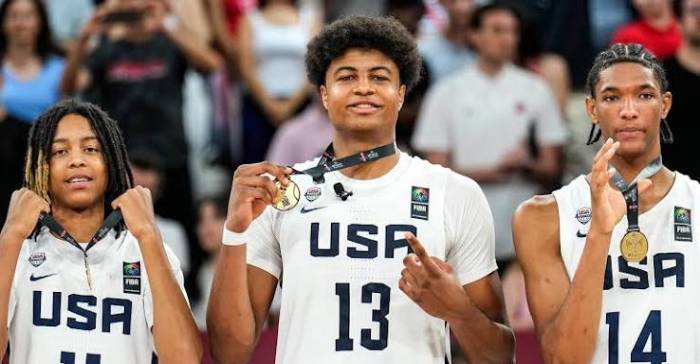
The 2026 FIBA U17 Basketball World Cup, held June 27 through July 5 in Istanbul, Türkiye, once again served as one of the world’s premier showcases for young basketball talent. Team USA captured its eighth consecutive FIBA U17 World Cup title, dominating the competition and winning every game by a comfortable margin behind Tournament MVP Joaquim Boumtje-Boumtje. The victory also extended the United States’ perfect all-time record in FIBA U17 World Cup competition to 58-0. Already having established himself across multiple major events, Boumtje further solidified his status as the top prospect in the 2028 class. The tournament also featured an outstanding international group led by Nikola Kusturica of Serbia and Nathan Soliman of France, both of whom strengthened their standing among the top prospects outside the United States.
Projecting 16- and 17-year-old players is never an exact science, but the FIBA U17 World Cup has consistently proven to be one of basketball’s premier scouting events. Based on the talent assembled in Istanbul, the 2028 NBA Draft is already shaping up to be one of the stronger classes in recent memory at the top. Simply watching the top five or six performers at this event offered a glimpse of a group with legitimate NBA star potential, making this tournament an invaluable early evaluation opportunity for scouts.
Elite Prospects
Joaquim Boumtje-Boumtje
Forward | 6’11” | Born: May 30, 2009 | FC Barcelona (Spain) | USA
Tournament Stats: 19.6 PPG, 10.9 RPG, 2.0 APG, 2.1 BPG, 1.7 SPG, 55 of 92 (59.8%) FG, 17 of 32 (53.1%) 3PT, 22 of 25 (88.0%) FT
Boumtje Boumtje entered the tournament as arguably the world’s top high school prospect and only strengthened that reputation over seven outstanding performances. The Tournament MVP led Team USA to another gold medal while impacting every aspect of the game. Whether scoring, rebounding, defending or facilitating offense, he consistently separated himself through his unique blend of size, skill, athleticism and feel for the game.
Headed to Duke for the next two seasons, Boumtje Boumtje possesses one of the rarest combinations of size and perimeter skill in amateur basketball. Standing nearly seven feet tall, he plays like a modern face-up power forward, comfortably handling the ball in transition, initiating offense from the perimeter and attacking defenders off the dribble. Duke may have landed a modern-day Chris Webber for the next two seasons, a comparison that may not sit well with Michigan (Fab Five) fans, but one that reflects Boumtje Boumtje’s uncommon versatility and basketball instincts.
One of his biggest strengths is his passing. Boumtje Boumtje repeatedly recognized backdoor cuts before they developed, delivering perfectly timed passes that many players his age simply do not see. He consistently made the extra pass and played within the flow of the offense rather than forcing difficult shots.
His perimeter shooting also took another significant step forward. Boumtje Boumtje knocked down 17 of his 32 (53.1%) three-point attempts while converting 22 of his 25 (88.0%) free throws, forcing defenses to respect him well beyond the arc and opening driving lanes where he excelled attacking closeouts.
Defensively, he was equally impactful. His active hands disrupted passing lanes, his mobility allowed him to switch comfortably onto smaller players and his length made him an outstanding rim protector. Against Japan, he looked like a shot-blocking machine, repeatedly erasing attempts around the basket with exceptional timing and instincts.
Boumtje Boumtje plays with uncommon maturity, rarely forcing the action and consistently making winning basketball plays. There is still room to continue adding strength, but very few weaknesses currently exist in his overall profile. If his development continues along its current trajectory, he should enter the 2028 NBA Draft as the leading candidate to become the No. 1 overall selection.
AJ Williams
Wing | 6’7” | Born: June 28, 2009 | Eagles Landing High School (McDonough, GA)
Tournament Stats: 14.0 PPG, 6.6 RPG, 40 of 94 (42.6%) FG, 14 of 33 (42.4%) 3PT, 4 of 6 (66.7%) FT
Beckham Black
Point Guard | 6’2” | Born: January 30, 2009 | Southeastern Prep (Orlando, FL) | USA
Tournament Stats: 12.3 PPG, 3.7 RPG, 8.3 APG, 3.0 SPG, 34 of 65 (52.3%) FG, 11 of 28 (39.3%) 3PT, 7 of 8 (87.5%) FT
CJ Rosser
Forward | 6’9” | Born: April 21, 2009 | Northern Nash High School (Rocky Mount, NC) | USA
Tournament Stats: 16.4 PPG, 3.7 RPG, 38 of 74 (51.3%) FG, 11 of 30 (36.7%) 3PT, 28 of 37 (75.7%) FT
CJ Rosser arrived in Istanbul as one of Team USA’s premier long-term prospects and left looking every bit the part of a future NBA lottery pick. The 6-foot-9 forward averaged 16.4 points while helping the United States capture another FIBA U17 World Cup title, consistently showcasing a rare blend of elite athleticism, length and skill that solidified his standing among the top prospects in the 2028 class. He saved his best for last, scoring 23 points in the gold medal game against Serbia while connecting on 4 of his 5 three-point attempts.
Rosser’s greatest strength is his exceptional physical profile. An elite athlete with outstanding explosiveness, he plays well above the rim and covers ground effortlessly in transition and on the defensive end. Long, rangy and incredibly fluid, he combines speed, vertical pop and body control in a way few players his age can match. Few players in the tournament possessed his combination of size, mobility and defensive upside, giving him the tools to impact the game on both ends of the floor.
What separates Rosser from many elite athletes is the polish of his offensive game. He consistently ran the floor for easy baskets, attacked closeouts, finished through contact and displayed an increasingly reliable perimeter jumper, knocking down 11 of 30 (36.7%) three-point attempts. His mechanics continue to improve, and he looks comfortable spotting up or stepping into shots in rhythm. He also showed encouraging feel as a passer, making quick, unselfish reads and demonstrating the vision to create opportunities for teammates.
Defensively, Rosser projects as one of the more versatile forwards in his class. His length allows him to contest shots without fouling, recover quickly after switches and disrupt passing lanes. He consistently altered shots around the basket while demonstrating the lateral quickness to defend multiple positions. His combination of athleticism, timing and instincts gives him the tools to become a high-impact defender as he continues to develop.
The biggest question moving forward will be his overall development. Rosser remains relatively lean and will need to continue adding functional strength while refining the finer points of his game as he matures. If he continues progressing physically and skill-wise, he has the talent to emerge as one of the premier forwards in the 2028 NBA Draft. His performance in Istanbul, particularly his strong showing in the championship game, reinforced why evaluators continue to view him as one of the class’s most intriguing long-term prospects.
Nikola Kusturica
Wing/Forward | 6’8” | Born: April 30, 2009 | FC Barcelona (Spain) | Serbia / *UCLA
Tournament Stats: 24.6 PPG, 6.9 RPG, 2.7 APG, 58 of 124 (46.8%) FG, 13 of 50 (26.0%) 3PT, 43 of 59 (72.9%) FT
Nathan Soliman
Forward | 6’8” | Born: May 14, 2009 | Nantes Basket Hermine | France
Tournament Stats: 17.6 PPG, 7.0 RPG, 2.9 APG, 44 of 76 (57.9%) FG, 11 of 26 (42.3%) 3PT, 24 of 33 (72.7%) FT
Soliman entered the tournament as one of Europe’s premier young forwards and consistently validated that reputation against elite competition. The versatile French standout combines outstanding size, skill and feel for the game, giving him one of the highest long-term ceilings among the international prospects in Istanbul.
A true modern combo forward, Soliman is comfortable playing either forward position. He possesses excellent ball-handling ability for a player his size and consistently created offense off the dribble throughout the tournament. His ability to attack defenders in space, change directions and create quality scoring opportunities is especially impressive considering both his age and physical profile.
One of Soliman’s biggest strengths is his shooting. He knocked down 11 of his 26 (42.3%) three-point attempts while converting 24 of his 33 (72.7%) free throws, proving equally comfortable spotting up or stepping confidently into catch-and-shoot opportunities. Against Team USA, he showcased his advanced offensive skill set by scoring 18 points on 6-of-7 shooting, highlighted by a smooth turnaround jumper that displayed his footwork, balance and touch.
Despite being listed at 6-foot-8, Soliman often played bigger than his height thanks to his long arms, outstanding reach and ability to impact plays above the rim. He regularly attacked the basket with authority, finishing over defenders while using his length and body control to complete difficult plays in traffic. His combination of athleticism, length and skill makes him particularly difficult to match up against.
Soliman also demonstrated excellent passing instincts throughout the tournament, averaging 2.9 assists per game. Comfortable operating as a face-up four, he consistently made smart reads off the dribble and found open teammates when defenses collapsed. His blend of ball handling, passing and perimeter shooting allows him to function as much more than a traditional power forward.
His overall package is extremely impressive. Between his length, long arms, athleticism, shooting ability and advanced offensive skill set, Soliman possesses the tools of a modern NBA forward. If his development continues on its current path, he has the talent to develop into a legitimate top-five candidate in the 2028 NBA Draft.
International Standouts
Isaiah Hamilton
Small Forward | 6’5” | Born: October 27, 2009 | Crestwood Preparatory College (CAN) | Canada
Tournament Stats: 14.0 PPG, 4.4 RPG, 34 of 85 (40.0%) FG, 15 of 46 (32.6%) 3PT, 15 of 24 (62.5%) FT
Hamilton entered the tournament carrying the reputation as one of Canada’s premier young prospects and a consensus top-five player in the 2028 recruiting class. Despite facing constant defensive attention as Canada’s primary scoring option, he consistently showcased the shot creation and scoring instincts that have made him one of the most highly regarded wings in North America.
A smooth, athletic 6-foot-5 wing, Hamilton is capable of creating offense both with and without the basketball. He possesses a polished handle, changes pace effectively and consistently creates separation off the dribble. His offensive versatility stood out throughout the tournament, as he showed the ability to score from all three levels while remaining confident against high-level international competition.
Hamilton’s perimeter shooting remains one of the more intriguing parts of his game. While his percentages fluctuated throughout the event, he never hesitated to take big shots and displayed fundamentally sound mechanics that project well long term. He also attacked the basket aggressively, using his athleticism and body control to finish through contact and keep pressure on opposing defenses.
Defensively, Hamilton has the physical tools to become an impact wing. He moves well laterally, competes on the glass and has the length and athleticism to defend multiple perimeter positions. As he continues adding strength and experience, his defensive consistency should continue improving.
Hamilton possesses the combination of athleticism, shot creation and offensive confidence that NBA scouts covet in modern wings. Although his efficiency was impacted by the heavy offensive burden he carried, his talent was evident throughout the tournament. With continued physical development and improved shot selection, he has all the tools to justify his standing among the elite prospects in the 2028 class.
Emmanuel Ouedraogo
Center | 6’10” | Born: November 5, 2010 | Wilson Academy (USA) | Côte d’Ivoire
Tournament Stats: 10.4 PPG, 9.0 RPG, 1.4 APG, 2.0 BPG, 34 of 54 (63.0%) FG, 0 of 1 (0.0%) 3PT, 5 of 9 (55.6%) FT
Forward | 6’8” | Born: June 21, 2009 | Pôle France | France
Tournament Stats: 12.7 PPG, 6.3 RPG, 40 of 68 (58.8%) FG, 9 of 13 (69.2%) FT
Yangala may be one of the tournament’s best pure athletes. The explosive French wing immediately stood out with his length, speed and ability to play well above the rim. His physical tools alone make him one of the more intriguing long-term prospects in the event.
Defensively, Yangala was at his best. He consistently rotated from the weak side to block shots, averaging 1.4 blocks per game while using his timing and athleticism to erase scoring opportunities. Despite playing on the wing, he showed the instincts of an interior defender while remaining mobile enough to defend on the perimeter. His length also made him a strong rebounder, averaging 6.3 boards per contest.
Offensively, Yangala remains a work in progress, but his upside is obvious. He runs the floor extremely well, attacks the basket aggressively and finishes with authority around the rim, converting an efficient 40 of his 68 (58.8%) field-goal attempts. While he did not attempt a three-pointer during the tournament, continued improvement with his perimeter shooting and ball handling would significantly raise his offensive ceiling.
Players with Yangala’s combination of length, athleticism and defensive versatility are difficult to find. His long-term upside remains among the highest of the international wings in this class.
Luke Paul
Guard | 6’5” | Born: February 20, 2009 | Cairns Taipans (Australia) | Australia
Tournament Stats: 15.3 PPG, 5.4 RPG, 7.1 APG, 30 of 62 (48.4%) FG, 10 of 18 (55.6%) 3PT, 37 of 48 (77.1%) FT
Paul put together one of the more well-rounded performances among the international guards, leading Australia’s offense with an impressive combination of size, playmaking and versatility. The 6-foot-6 combo guard averaged 15.3 points and 7.1 assists while consistently making smart decisions with the basketball and impacting the game in multiple ways.
A solid athlete with good length and fluidity, Paul possesses excellent positional size for a lead guard. He handles the ball comfortably, changes speeds well and does an excellent job reading the floor. While Paul isn’t an overly fast or explosive athlete, he plays at his own pace and consistently gets where he wants to go. His outstanding feel for the game, court awareness and decision-making allow him to create opportunities without relying on elite quickness. He does an excellent job driving and kicking to open teammates, displaying very good vision and consistently making the right read when the defense collapses.
Paul also proved to be an efficient scorer. He attacked the basket under control, finished effectively around the rim and showed a reliable perimeter stroke, knocking down 10 of 18 (55.6%) from three-point range. His ability to contribute both as a scorer and facilitator makes him a difficult player to defend.
Defensively, his length and mobility allow him to guard either backcourt position, and he contributed on the glass with 5.4 rebounds per game. He still needs to add strength and improve his overall explosiveness, but his physical tools provide a solid foundation for continued development.
With his combination of size, passing ability, shooting touch and basketball IQ, Paul established himself as one of the more intriguing international guards in Istanbul. As he continues to get stronger and more physically mature, he has the tools to continue climbing as a prospect.
Omer Kutluay
Guard | 6’3” | Born: October 21, 2009 | Anadolu Efes | Türkiye
Tournament Stats: 28.0 PPG, 6.8 RPG, 9.8 APG, 48.2 FG%, 31.7 3PT%, 75.6 FT%
Kutluay established himself as one of the premier international guards in the tournament, combining elite production with outstanding feel for the game. He consistently controlled the tempo for Türkiye while leading one of the event’s most entertaining offenses. Averaging nearly 28 points and 10 assists per game is remarkable regardless of level, but doing so against elite international competition further elevated his draft stock.
A big lead guard with excellent positional size, Kutluay plays with tremendous poise and confidence. He comfortably orchestrates the offense, keeps defenders guessing with changes of pace and consistently delivers accurate passes to teammates. His court vision is among the best in the tournament and he showed the ability to create quality opportunities for both himself and others.
Kutluay is also a gifted scorer. He can create separation off the dribble, finish through contact and knock down perimeter jumpers when defenders play off him. Continued improvement with his three-point consistency will only make him more difficult to defend.
The son of legendary Turkish shooting guard Ibrahim Kutluay, Omer appears to have inherited his father’s special feel for the game. While their styles are not identical, he plays with the same confidence, instincts and natural offensive creativity that made his father one of Türkiye’s greatest players.
His combination of size, playmaking ability and offensive production gives him legitimate first-round potential. If he continues progressing physically and improves defensively, Kutluay has the tools to develop into one of Europe’s top guard prospects.
Matija Lukic
Shooting Guard | 6’7” | Born: October 19, 2009 | Basket Zaragoza 2002 SAD (Spain) | Serbia
Tournament Stats: 16.1 PPG, 4.4 RPG, 2.4 APG, 39 of 78 (50.0%) FG, 18 of 43 (41.9%) 3PT, 17 of 27 (63.0%) FT
Lukić quietly emerged as one of the tournament’s more impressive international wings, providing Serbia with a consistent secondary scoring option alongside Nikola Kusturica. The 6-foot-7 shooting guard combines excellent positional size with a smooth perimeter game, giving him intriguing long-term upside.
A thin, wiry wing with room to add strength, Lukić is an effective three-level scorer who plays comfortably on or off the ball. His biggest offensive weapon is his perimeter shooting, where he consistently knocked down pull-up jumpers and catch-and-shoot threes with a smooth, repeatable release. He connected on an impressive 18 of 43 (41.9%) from beyond the arc while demonstrating confidence in big moments, including a 27-point performance against Lithuania and 20 points in the semifinal win over Türkiye.
Beyond his shooting, Lukić showed good feel for the game. He moves well without the basketball, attacks closeouts under control and generally makes sound decisions rather than forcing offense. While not an explosive athlete, he uses his size, skill and pace effectively to create quality scoring opportunities.
Defensively, Lukić’s length gives him the potential to guard multiple perimeter positions as he continues to fill out physically. Adding strength will be an important part of his development, allowing him to better handle physical wings while becoming more effective finishing through contact.
With his combination of size, shooting ability and offensive polish, Lukić established himself as one of the better wing prospects in the tournament. As his body continues to mature and his all-around game expands, he has the tools to continue climbing among the top international prospects in his class.
Amadou Fall
Guard | 6’5” | Born: Jan 27, 2009 | France
Tournament Stats: 10.3 PPG, 3.4 RPG, 3.1 APG, 25 of 52 (48.1%) FG, 11 of 27 (40.7%) 3PT, 11 of 18 (61.1%) FT
Fall emerged as one of France’s most intriguing backcourt prospects, showcasing an impressive blend of size, athleticism and offensive versatility. The 6-foot-5 combo guard possesses good length and moves with a smooth, effortless style that immediately stands out.
Offensively, Fall displayed a fundamentally sound shooting stroke, knocking down 11 of his 27 (40.7%) three-point attempts while consistently looking comfortable creating offense. He attacked defenders aggressively off the bounce, using long strides and body control to get into the paint while finishing through contact or creating opportunities for teammates. His scoring ability was evident throughout the tournament, but his willingness to move the basketball was equally encouraging, averaging 3.1 assists while generally playing within the flow of the offense.
Fall’s physical profile gives him considerable defensive upside as well. With continued strength development, he projects as a player capable of defending either guard position while using his length to disrupt passing lanes.
France continues producing versatile perimeter players with NBA potential, and Fall appears to be another strong example. His combination of size, athleticism and offensive skill makes him an intriguing long-term prospect.
Team USA Standouts
Cayden Daughtry
Point Guard | 6’1” | Born: April 10, 2009 | Calvary Christian | USA
Tournament Stats: 11.7 PPG, 3.4 RPG, 4.7 APG, 25 of 44 (56.8%) FG, 9 of 20 (45.0%) 3PT, 23 of 28 (82.1%) FT
Daughtry proved to be one of Team USA’s most reliable perimeter shooters throughout the tournament. Although he was listed at just 5-foot-10 by FIBA, he recently measured just under 6 feet barefoot (5-foot-11½), putting him closer to 6-foot-1 in shoes. Combined with a solid wingspan and impressive explosiveness, he possesses better physical tools than his listed height might suggest.
He consistently spaced the floor while demonstrating outstanding confidence from beyond the arc. His shooting mechanics are fundamentally sound, and he showed the ability to knock down shots both off the catch and when defenders went underneath screens. Daughtry connected on 9 of his 20 (45.0%) three-point attempts while adding 4.7 assists per game, showing he was capable of both creating for teammates and stretching opposing defenses.
Beyond his shooting, Daughtry displayed the poise expected from a true lead guard. He made smart decisions with the basketball, kept the offense organized and consistently played under control. His combination of shot-making, passing and competitiveness made him one of Team USA’s steadiest performers throughout the event.
The biggest question surrounding Daughtry moving forward is continued physical development. While additional height would always be beneficial, his recent measurements, strong wingspan and elite leaping ability suggest his size may not be as limiting as originally believed. He also remains one of the younger players in his class and still has considerable time to mature physically.
Regardless of where his body ultimately develops, Daughtry’s shooting ability, decision making and feel for the game make him one of the more intriguing guards in the 2028 class. Given his skill level, athleticism and competitive makeup, he should not be overlooked as a potential one-and-done prospect for the 2028 NBA Draft.
JJ Crawford
Guard | 6’4” | Born: June 5, 2010 | Rainier Beach High School (Seattle, WA) | USA
Tournament Stats: 3.8 PPG, 1.0 RPG, 1.2 APG, 7 of 17 (41.2%) FG, 5 of 12 (41.7%) 3PT
One of the youngest players in the tournament, Crawford flashed enormous long-term upside despite playing a limited role on Team USA’s loaded roster. Born in 2010, he is still physically immature compared to many of the older players in the field, making his flashes of brilliance even more encouraging. Despite his age, Crawford has already been mentioned by some evaluators as a potential future No. 1 prospect in all of high school basketball, underscoring just how highly regarded his long-term talent is.
Crawford possesses a slick handle and smooth athleticism while showing the versatility to develop into a dynamic combo guard. His body still has considerable room to develop. Thin, with long arms and legs at this stage, he appears to have additional growth ahead of him, and his large feet suggest he could continue getting bigger and stronger over the next several years.
While his production was limited, that was largely a product of Team USA’s extraordinary depth rather than his talent level. He simply didn’t receive the same opportunities as some of the older players ahead of him in the rotation. Crawford remains one of the highest-upside guards in the tournament and one of the elite prospects in his class. As his body matures and his opportunities expand, he has the talent to emerge as one of the headliners of the 2028 NBA Draft class.
Asa Montgomery
Wing | 6’6” | Born: July 20, 2009 | Hillgrove High School (Powder Springs, GA) | USA
Tournament Stats: 9.7 PPG, 4.4 RPG, 2.1 APG, 28 of 42 (66.7%) FG, 2 of 12 (16.7%) 3PT, 10 of 12 (83.3%) FT
Asa Montgomery quietly put together one of the more impactful tournaments for Team USA, averaging 9.7 points, 4.4 rebounds and 2.1 assists while shooting an outstanding 66.7 percent from the field. Although he wasn’t one of the team’s primary scoring options, he consistently made winning plays through his energy, athleticism and defensive versatility, reinforcing his status as one of the more intriguing two-way wings in the 2028 class.
Montgomery’s biggest strength is his high-level athleticism. An explosive leaper with a powerful, well-proportioned frame, he thrives in the open floor where he can finish above the rim with authority. Few players were as dangerous in transition, as he routinely turned defensive stops into highlight-reel finishes. He punctuated the gold medal game against Serbia with several steals that led directly to breakaway dunks, showcasing the type of explosiveness that makes him a constant threat in the open court. His combination of burst, strength and body control allows him to play bigger than his size and impact the game without needing plays called for him.
Defensively, Montgomery established himself as one of Team USA’s most reliable perimeter defenders. He competes on every possession, moves well laterally and has the physical tools to defend multiple positions on the wing. His active hands generated steals, he consistently made hustle plays and he embraced difficult defensive assignments throughout the tournament. His ability to create turnovers and immediately convert them into transition offense adds another dimension to his value and highlights the type of two-way impact he can have.
Offensively, Montgomery was highly efficient attacking the basket, cutting without the ball and finishing around the rim. His outside shot remains a work in progress, as evidenced by his 2-for-12 (16.7 percent) performance from three-point range, and extending his shooting range will be an important area of development. However, there are encouraging signs. His mechanics are fundamentally sound, and his 83.3 percent free throw shooting suggests he has the touch to become a reliable perimeter shooter over time. As his range continues to develop, it should open up even more opportunities for him to take advantage of his explosive first step and athletic finishing ability.
Montgomery’s combination of elite athleticism, defensive intensity and long-term shooting potential makes him one of the more appealing developmental wing prospects in the 2028 class. While his perimeter game still has room to grow, his physical tools, competitiveness and ability to create highlight plays in transition give him an extremely high ceiling on both ends of the floor.
Navarro Bowman Jr.
Point Guard | 6’3” | Born: June 3, 2009 | Notre Dame High School | USA
Tournament Stats: 11.9 PPG, 2.7 RPG, 3.6 APG, 37 of 62 (59.7%) FG, 4 of 16 (25.0%) 3PT, 5 of 7 (71.4%) FT
Bowman quietly put together an excellent tournament while showing many of the qualities NBA teams value in lead guards. The son of former San Francisco 49ers All-Pro linebacker NaVorro Bowman, he brings an impressive athletic pedigree along with a polished floor game.
Bowman is an outstanding ball handler who consistently keeps his dribble alive while probing the defense. He often backed defenders down without picking up his dribble, forcing help defenders to commit before finding open teammates. His court vision and passing instincts stood out throughout the tournament.
He also displayed excellent shooting mechanics with a smooth, fundamentally sound release that projects well as his game continues to mature. At 6-foot-3, he has a similar build and style to Collin Sexton, combining quickness, toughness and an attacking mentality while playing with the confidence to create offense for both himself and his teammates.
Combined with his athleticism, confidence and feel for the position, Bowman looks every bit like a future professional point guard.
Jordan Page
Wing | 6’6” | Born: May 5, 2009 | Broughton Magnet High School (Raleigh, NC) | USA
Tournament Stats: 9.8 PPG, 1.4 RPG, 1.9 APG, 23 of 33 (69.7%) FG, 1 of 4 (25.0%) 3PT, 12 of 12 (100%) FT
Page quietly put together one of the more efficient tournaments on Team USA’s loaded roster. The left-handed wing combines a sturdy, well-built frame with good athleticism and continued to show why he remains one of the more intriguing long-term wings in the 2028 class.
Physically, Page already possesses an NBA-type build for a perimeter player. His strength allows him to absorb contact, finish through defenders and defend multiple positions. He also proved to be a dependable perimeter defender, using his physicality and competitiveness to stay in front of ball handlers and contest shots without gambling.
Offensively, Page displayed a solid shooting stroke and showed continued growth as a perimeter scorer. He played within himself, rarely forcing difficult shots while consistently making the right basketball play. Although known for his strength, he also reminded scouts of his athletic ability, throwing down one of the tournament’s most impressive dunks against Japan in a play that highlighted his explosiveness.
Page may not receive the same attention as some of Team USA’s headline prospects, but his combination of size, athleticism, shooting ability and defensive versatility gives him an excellent foundation moving forward.
Xavier Young
Center | 6’9” | Born: March 4, 2010 | Faith Family Academy (Dallas, TX) | USA
Tournament Stats: 7.6 PPG, 3.7 RPG, 21 of 27 (77.8%) FG, 11 of 20 (55.0%) FT, 5 BLK
Young was one of the youngest players in the tournament, having been born in 2010, and his long-term upside remains significant. Already possessing a strong frame and excellent length, he has the physical foundation NBA teams covet in a developing frontcourt prospect.
Offensively, Young remains somewhat raw. His perimeter shooting is still developing, but he showed the ability to score efficiently around the basket by converting 21 of his 27 (77.8%) field-goal attempts, using his size, strength and athleticism to consistently finish around the rim. As his skill level continues to improve, particularly facing the basket, his offensive ceiling should rise considerably.
Defensively, Young’s physical tools allow him to rebound, protect the rim and compete against older competition despite giving away valuable developmental time. He averaged 3.7 rebounds while blocking five shots over seven games, flashing the instincts and length to develop into an impactful interior defender as he continues to mature physically.
Considering his age, Young remains one of Team USA’s more intriguing long-term developmental prospects.
[Player: Erick Dampier] Jr.
Center | 6’9” | Born: October 22, 2009 | Madison-Ridgeland Academy (Madison, MS) | USA
Tournament Stats: 5.0 PPG, 5.7 RPG, 3.3 APG, 17 of 22 (77.3%) FG, 1 of 4 (25.0%) FT, 5 BLK
Dampier entered the tournament as one of Team USA’s developmental big men and showed flashes of why scouts remain intrigued by his long-term potential. The son of former NBA center Erick Dampier, he possesses excellent length and a frame that should continue adding considerable strength over the coming years.
Still somewhat raw physically, Dampier projects as more of a long-term prospect than an immediate one-and-done candidate. He appears to be several years away from reaching his full potential, with his body expected to continue filling out while becoming stronger and more fluid as he matures.
One encouraging aspect of his tournament was his passing. Dampier averaged an impressive 3.3 assists per game and delivered several outstanding outlet passes that highlighted his court awareness and willingness to initiate transition opportunities. Combined with his length, rebounding ability and efficient finishing around the basket, those flashes suggest there is more offensive upside than his statistics alone indicate.
Dampier appears likely to benefit from multiple years of college development, but his size, physical tools and improving feel for the game make him a player worth monitoring over the long term.
Mason Collins
Wing | 6’5” | Born: August 20, 2009 | Irmo High School (Columbia, SC) | USA
Tournament Stats: 7.1 PPG, 3.3 RPG, 3.1 APG, 23 of 43 (53.5%) FG, 3 of 14 (21.4%) 3PT, 1 of 1 (100.0%) FT, 2.1 SPG
Collins may not possess the same elite upside as some of Team USA’s headline prospects, but he quietly demonstrated a solid all-around foundation throughout the tournament. Standing 6-foot-5, he has good size for a wing and plays a fundamentally sound game built around skill and basketball IQ.
His game brings to mind a smaller version of Patrick Baldwin Jr. Collins handles the ball well, moves effectively without it and displayed a smooth shooting stroke throughout the event. While he connected on just 3 of 14 (21.4%) three-point attempts, his mechanics suggest continued improvement as he gains experience.
Collins also made consistently good decisions, averaging 3.1 assists while playing within the offense and contributing as a secondary ball handler. Defensively, he was one of Team USA’s most disruptive perimeter players, averaging 2.1 steals per game thanks to his instincts, activity and anticipation. He competes defensively and understands his role, traits coaches consistently value.
At this stage, Collins appears more likely to follow a traditional multi-year college path than an immediate NBA trajectory. Nevertheless, his combination of size, passing ability, defensive instincts and feel for the game gives him a solid long-term foundation and makes him a player worth following over the next several seasons.


